1776, 1870, 1960... and now, 2026.
A Moment To Define America’s Next Century.
This is not the first time America has been at a crossroads like this.
In 1776, few men truly understood what was being built. It was the birth of a new nation, yes. But it was much, much more:
A new system of commerce, law, and self-governance unlike anything the world had seen. Built on treatises like Adam Smith’s Wealth of Nations – which defined the next 250 years of American capitalism.
These men who understood the truth of this moment became the architects of the greatest economic expansion in history .
Most people – even most “new” Americans – didn’t understand. Many resisted the change, some violently…
History rarely remembers them. They are not the ones with great legacies of wealth or achievement. They are the masses, forgotten to time. But at every major technological, economic, and geopolitical crossroads, this group has existed.
The same divide appeared during the Industrial Revolution... During the electrification of America… During the rise of the internet.
In every case, the gap between the people who understood the transition and the people who didn’t wasn’t a matter of luck or intelligence.
It was a matter of openness and attention to what was actually happening. It was a quick acceptance of a new reality… and a material shift to align with that new reality.
Right now, most Americans are staring at the headlines in fear and wonder.
From the war in the Middle East, to the rise of AI, to the U.S. government that has upended decades of neoliberal tradition in a matter of months…
While most Americans fail to see what’s actually happening underneath it all… A select few will once again see the truth – that this is America’s new 1776 moment.
These few understand that what we’re facing is one of the greatest opportunities in human history to build wealth...
That’s because economics, technology, and geopolitics are colliding to create what could be the largest wealth transfer in American history.
In my free briefing, I explain everything you need to know about this event. I connect the dots for you. I will show you how this pattern has happened again and again throughout history…
And I’ll show you how to be one of the elite few who both understand and act on this new national moment.
It’s as easy as owning the correct assets. The stocks to buy… the stocks to sell… and the three money moves to best position yourself to ensure you're on the winning side of this new reality.
It’s all right here.
CLICK HERE TO SEE THE "NEW 1776" BRIEFING (ad)
250 Years of Independence. Your Capital Sovereignty Starts Now.
Tomorrow, the United States turns 250 years old.
The media cycle is packed. Two rival federal programs — the Congress-led America250 and the White House's Freedom 250 — are staging dueling events on opposite coasts. 850,000 fireworks are set for a 40-minute show over the National Mall. Tall ships from 32 nations are lining up in New York Harbor. A time capsule will be buried under Independence Hall, sealed until 2276.
The show is massive. The staging is on purpose.
None of it changes the fiscal state of the nation hosting the party.
On June 26, S&P Global Ratings held the United States at AA+ — one notch below the top grade — with a stable outlook. Fitch holds the same mark. Moody's cut to Aa1 in 2025. All three major agencies now rate the U.S. below the top credit tier for the first time ever.
This is not a crisis headline. It is a hard fact. Hard facts are what Individual Sovereigns build on.
This memo does not aim to dismiss the founding. It aims to split the ceremony from the capital reality. The readers of this brief need to see what the fiscal data under the party means for how they hold assets.
The fireworks fade. The deficit path does not.
Wind. Solar. EVs. Dead. This One Survived.
24 days after a drilling crew cracked open 15,765 feet of granite in a remote Utah desert…
President Trump signed a law that killed tax credits for wind, solar, and electric vehicles.
Every renewable energy source in America.
Except one.
The DOE then quietly eliminated the entire Office of Renewable Energy — and reclassified this single resource alongside oil and nuclear.
Google signed a 15-year deal for it.
The Pentagon is backing it.
And one small company sitting at the center of it all could hand early investors gains of 1,000% or more.
See what Trump, Google, and Berkshire Hathaway all know — and why a July 4th deadline could send this stock soaring.
(ad)
2. What AA+ Really Means at the Capital Layer
The mainstream story frames the S&P call as comfort. "Stable outlook" grabs the headline. Markets relax. The news moves on.
That is a surface read. Here is what the data says.
S&P projects the federal deficit will average 6.0% of GDP from 2026 to 2029. This is not a downturn deficit. This is a built-in gap during a time of growth — a rare trait among top-rated nations.
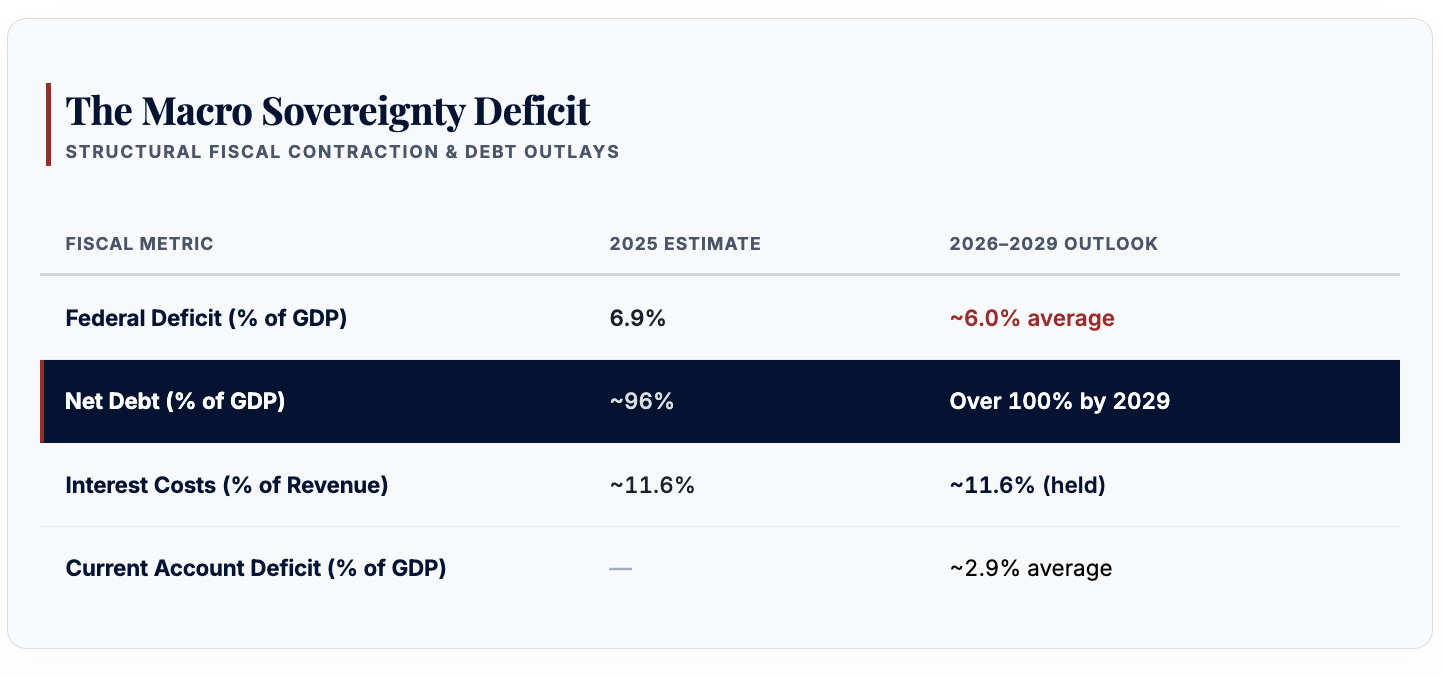
S&P warned the rating could face downward pressure within two years if deficits grow from spending failures or lost revenue due to tax changes.
The key phrase from S&P: **the two parties cannot agree on how to cut deficits.** Sharp policy swings from deep divides are why the rating sits at AA+ — not AAA.
For Individual Sovereigns, the takeaway is clear. The nation whose currency backs your savings, your brokerage, and your retirement checks runs a permanent gap with no real plan to close it. Interest costs alone eat nearly 12 cents of every dollar the government takes in.
This is not a political view. It is a balance sheet fact. It hits the buying power of every dollar you hold.
3. Two Parties, One Failing Fiscal Profile
I spent enough years inside large firms to spot a branding push meant to draw eyes from weak results. The 250th is, at its core, a dual-track brand campaign laid over a crumbling fiscal base.
America250, the bipartisan panel Congress set up in 2016, runs a multi-year outreach plan aimed at all 350 million Americans. Its programs include volunteer drives, student trips, startup expos, and a "Giving 4th" charity push. The panel's mandate runs through December 31, 2027. Travel firms are already selling themed tour packages into next year to ride the buzz.
Freedom 250, launched by executive order in January 2025, runs its own rival slate: a Great American State Fair on the Mall, a UFC event on the White House grounds, military flyovers, an IndyCar race through D.C. streets, and a high school sports event called "The Patriot Games" in August.
Two federal programs. Separate leaders. Separate brands. Barely aware of each other. Internal records obtained by Time show a strained bond, clashing visions, and zero will to work together.
This is not unity. This is administrative drag at the national level — the same waste I watched eat budgets inside Fortune 500 firms for twenty years. Doubled costs. Rival stories. No synergy.
The mood data is blunt. Gallup says extreme national pride has dropped to 33% — the lowest in 25 years. A Pew survey found **59% believe the country's best days are past. An AP-NORC poll showed 72% say the nation is on the wrong track. And 66% reject the idea that the American dream — work hard and get ahead — still holds true.
The party is loud. The trust numbers are falling apart.
250th birthday flash sale
Until Monday, I'm opening the doors to my Power Gauge Report in a flash sale for America's 250th birthday.
I'm also offering a FREE year of access to my Power Gauge rating system, so you can look up any stock you want and see if it's rated Bullish or Bearish.
I've helped build three indexes for the Nasdaq during my 60 years on Wall Street, and you can find the tools I developed on every professional Bloomberg and Reuters terminal in the world.
My tools have helped billionaire investors grow their assets by as much as 69,000%.
And today, through this limited-time 4th of July sale, you can get my flagship rating system at no cost for a full year – as part of your Power Gauge Report membership.
Start here with an inside look at my powerful investing strategy that boils down to " Sell This, Buy That."
It's a way to rid yourself of overpriced AI stocks before the tech trade breaks down this summer...
And instead move that money into smaller, lesser-known names that are showing real potential to dethrone the Magnificent Seven.
I even give away a Hotlist and Hitlist of buy and sell ideas that you can act on right now.
Like my recommendation I call " an upgrade to Tesla stock." It's a little-known company that just inked a groundbreaking partnership with the king of AI, Nvidia. This deal virtually hands this under-the-radar firm the keys to the self-driving industry's biggest customers, putting them miles ahead of Tesla in the autonomous vehicle race.
That's why I want to put this stock on your radar before markets open.
Get the name and ticker symbol – plus my first-ever 4th of July discount – when you click here before it expires on July 6th.
(ad)
4. Global Risk as a Working Variable
The fiscal picture does not sit alone. It lives inside a global setting that has reshaped the risk profile of every capital choice you make.
From 2016 to 2026, the global framework shifted from lean global trade to economic nationalism as policy. Governments now routinely weaponize supply chains, impose sudden export bans on key materials, and deploy steep tariff plans to bring factories home.
S&P's own report notes this shift. The agency cited ongoing tariff income as part of U.S. revenue forecasts. Tariff money is now baked into the fiscal base. Trade friction is not a short-term shock. It is a permanent input to the national balance sheet.
For Individual Sovereigns with heavy stock positions, this creates a real risk that most retail portfolios miss. If your holdings rely on firms with single-source supply chains in tense regions, you carry hidden balance sheet risk that no dividend yield offsets.
The framework is simple:
- Check your exposure. Find holdings tied to lone suppliers in hostile or trade-sensitive zones.
- Price the political risk. A 15% cost edge sourced from an unstable region is not a savings — it is an open liability.
- Build backup. Favor firms with multi-region operations and proven backup supplier networks.
A nation running a 6% built-in deficit while using tariffs as a revenue tool is sending a signal about the landscape. The question is whether your capital plan reflects that truth or ignores it.
Independence Is Not a Holiday — It Is a Way of Operating
Tomorrow marks 250 years since a document declared a core idea: government exists to protect rights, not to hand them out. The governed do not owe blind loyalty. The system earns loyalty by doing its job.
That idea applies directly to your capital.
The nation hosting tomorrow's party runs deficits near 6% of GDP during growth. Its net debt will pass 100% of GDP within three years. Its credit rating sits below the top tier at all three agencies for the first time. Its leaders cannot agree on fiscal reform. And its own people — by every poll — report fading faith in the nation's path.
None of this calls for despair. It calls for clear thinking.
The old belief that your finances are safe through employer loyalty, government programs, or passive index funds is a liability — not an asset. The data does not back it. The credit agencies do not back it. The polls do not back it.
What the data does back is this: capital autonomy is the only lasting form of freedom. Building your own income base — through careful asset choices, simple options setups for cash flow, and strict removal of hidden portfolio risks — is not optional. It is the mission.
The Declaration of Independence was not a party. It was a clean break from a system that no longer served the people it ruled.
Your capital deserves the same clarity.
Operate accordingly.
— Patrick Gibson, The Reclaimed Capitalist
You can also like:
- Trump’s new tech bill could put quadrillions (ad)
- Annual Economic Report 2026 (BIS)
- The $15 Gold Fund That Pays Up to $1,152/Month (from Investors Alley)
- Ford rehires ‘gray beard’ engineers after AI falls short (TechCrunch)
- Footage reveals Nvidia’s secret robot breakthrough (ad)
Disclaimer: This analysis is for educational purposes only and should not be considered investment advice. Always do your own research before making investment decisions.
Items marked with an asterisk (*) are promotional and help support this newsletter at no cost to readers.