
Congress returns with a September 30 funding deadline and the CLARITY Act on the table. Here is the capital layer analysis.
The political machinery in Washington is spinning up its post-recess narrative engine.
As Congress returns from its August break, the mainstream press is preparing its usual theater: ticking clocks on cable news, late-night Capitol stairwell scrums, and dramatic warnings of a looming federal shutdown.
That is the media spectacle. Now look at the underlying balance sheet.
Lawmakers face a hard September 30 fiscal deadline to keep the federal government funded. But with the 2026 midterm elections just weeks away, this is not a genuine fiscal negotiation—it is a pre-election optics drill. Neither party intends to take the blame for locking the doors of the federal apparatus when control of Congress hangs in the balance.
Behind the government funding headlines lies a far more critical battle for capital allocators: the stalled CLARITY Act (H.R. 3633). This landmark legislation aims to establish the first definitive federal framework for digital assets, drawing a hard regulatory line between the SEC and the CFTC.
The central question for your portfolio isn't "Will the government close?"
The real question is: How will Congress balance short-term fiscal posturing against a structural re-architecting of the U.S. financial and digital asset framework before the midterm window shuts?
The Intelligence Brief: Pre-Election Optics vs. Fiscal Reality
What the media claims: Congress is on the brink of an explosive, catastrophic government shutdown over irreconcilable economic visions.
What is actually happening at the capital layer: Both chambers have already laid the groundwork for a temporary Continuing Resolution (CR) to push the real spending fight into the post-election "lame duck" session.
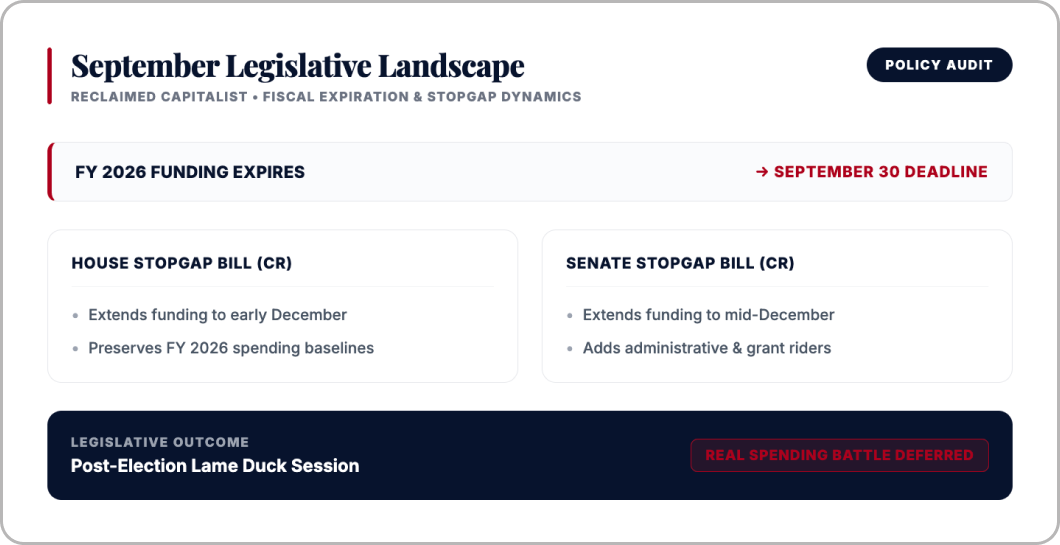
Neither side wants a shutdown to disrupt their campaign messaging around cost-of-living pressure:
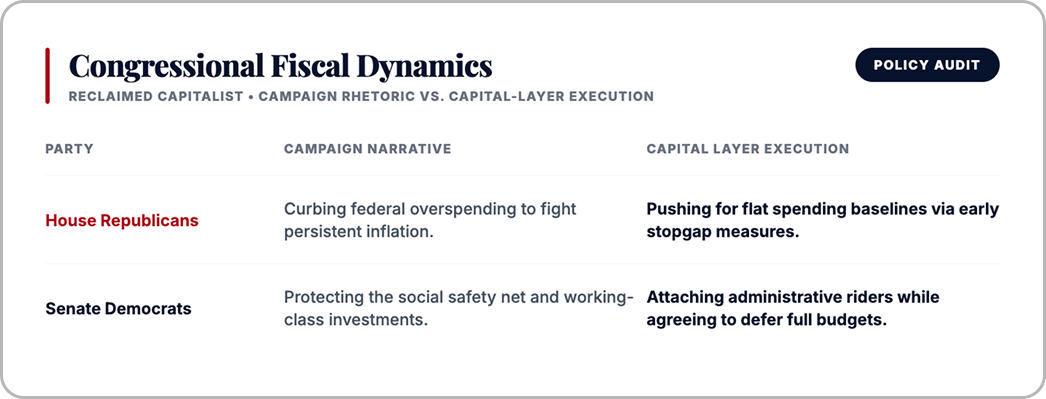
The budget theater is a headline distractor. The real capital movement sits in the policy riders and stalled legislative pipelines.
— Sponsored Briefing —
The “Rockefeller Moment” For Coal


In the 1800s, John D. Rockefeller started refining oil into the world's most valuable fuel. Now, another innovator is creating its own “Rockefeller Moment” with one of the world’s most abundant energy resources: coal.
This is more important than ever right now, because a perfect storm of operational breakthroughs and policy shifts has the potential to directly impact this company’s valuation.
What’s creating this “Rockefeller Moment” for coal?
Using their patented FASForm technology, Frontieras North America can transform coal into high-value commodities like hydrogen, diesel, jet fuel, and fertilizer, without burning it.
They’re targeting a $2.1 Trillion total addressable market* where demand for these commodities is virtually unlimited.
Reaching just 2% of the global coal market could mean a trillion-dollar valuation for Frontieras.
That’s why the institutional investors are already moving. Frontieras has secured a $150 million investment commitment from GEM and raised over $45 million from private investors.
But here’s why 2026 is shaping up to be such a historic year for this company:
- NASDAQ ticker reserved: Frontieras has officially reserved the “FASF” ticker, a major step toward a public listing. The “Big Beautiful Bill”: Under a White House that favors domestic energy, Frontieras is positioned for rapid scale. Real-world infrastructure: Frontieras just broke ground on their $850 million flagship facility in Mason County, West Virginia.
Frontieras is creating what could be a pivotal moment for the future of energy on the world stage.
Become a Frontieras shareholder before the opportunity ends on August 27.
This is a paid advertisement for Frontieras’s Regulation A offering. Please read the offering circular at https://invest.frontieras.com/
Reservation of the ticker symbol is not a guarantee that we will be listed on the NASDAQ. Listing on the NASDAQ is subject to approvals.
Under Regulation A, a company may change its share price by up to 20% without requalifying the offering with the Securities and Exchange Commission.
Sources* The global market for our products is worth a combined value of over $2.1 trillion
https://www.globenewswire.com/en/news-release/2022/03/24/2409228/0/en/Global-Diesel-Market-Size-To-Surpass-US-1269-87-Billion-By-2027-Europe-Having-Share-About-25-Leading-Players-Strategies-Covid-19-Outbreak-Growth-Opportunities-Emerging-Trends-Segme.html
https://www.marketsandmarkets.com/Market-Reports/hydrogen-market-132975342.html#:~:text=The%20global%20hydrogen%20market%20in,7.8%25%20from%202023%20to%202030
https://www.transparencymarketresearch.com/naphtha-market.html
https://www.fortunebusinessinsights.com/industry-reports/aviation-fuel-market-100427
https://www.marketresearchfuture.com/reports/anthracite-market-2742
https://www.precedenceresearch.com/fertilizer-market#:~:text=According%20to%20precedence%20research%2C%20the,USD%20271.6%20billion%20by%202032
The Tactical Strike: The CLARITY Act and the Battle for Financial Jurisdiction
While spending headlines dominate, the digital asset ecosystem is tracking H.R. 3633: The Digital Asset Market Clarity Act (CLARITY Act).
Passed by the House with a 294-134 bipartisan majority, the bill attempts to replace years of arbitrary "regulation by enforcement" with explicit statutory boundaries.
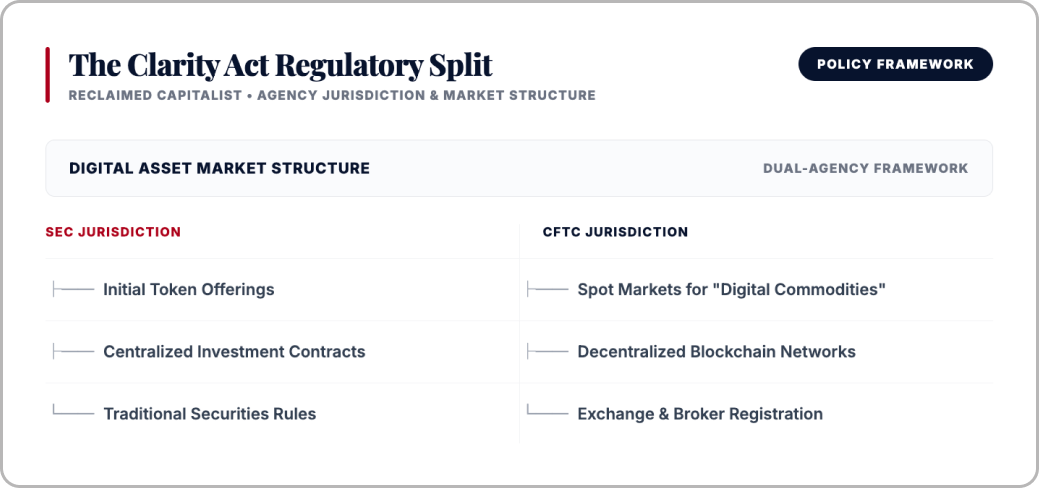
The SEC vs. CFTC Jurisdictional Division
- CFTC Spot Market Dominance: The bill grants the CFTC exclusive jurisdiction over "digital commodities". A token qualifies if its underlying network meets the "mature blockchain test"—meaning it is sufficiently decentralized and not controlled by a central promoter.
- SEC Security Retention: The SEC retains jurisdiction over traditional digital securities, initial token fundraising rounds, and investment contracts tied to centralized corporate issuers.
The Senate Standoff
Despite its momentum in the House, the bill faces friction in the Senate due to:
- Traditional Banking Lobbying: Incumbent financial institutions are pushing back on provisions that alter money market and yield mechanics.
- DeFi & Developer Safe Harbors: Debate remains active over non-custodial software developers and anti-surveillance language protecting open-source code.
Key Rule: Regulatory clarity reduces the equity risk premium for compliant platforms while accelerating the liquidation of non-compliant, centralized tokens.
The Corporate Weaponization: Regulatory Arbitrage in an Election Year
The stalling of structural legislation like the CLARITY Act is not an accident—it is a feature of Washington’s incentive structure in an election year.
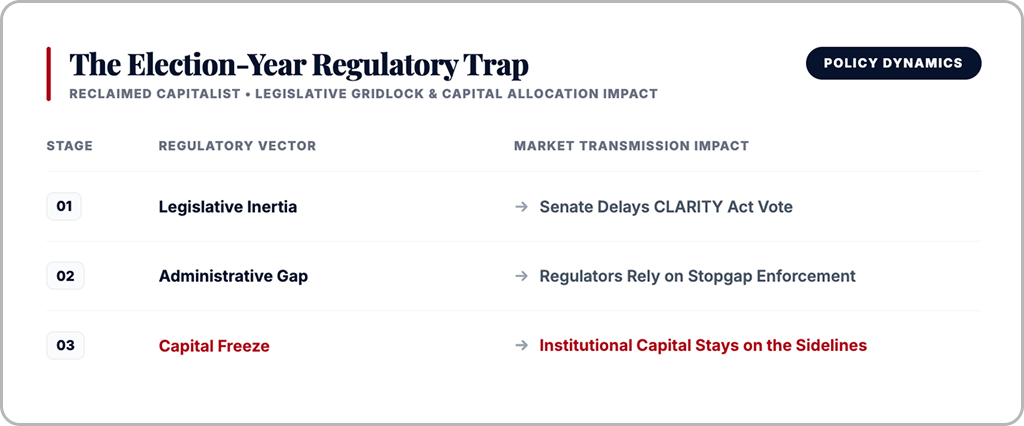
By deferring a full Senate vote on digital asset market structure, legacy financial interests preserve their incumbent moats while leaving digital asset firms dependent on temporary administrative guidance.
Institutional capital despises regulatory ambiguity. Until federal jurisdiction is codified by statute, institutional deployments into digital infrastructure will remain capped.
— Sponsored Briefing —
Bessent’s Warning to Americans
Scott Bessent went on record before anyone was paying attention.

"A new economic reordering."
His words.
Your retirement.
A direct line most Americans haven't drawn yet.
There's an IRS-approved position sitting inside the retirement account you already own.
It was designed exactly for a moment like this.
Bessent already told you what that moment looks like.
Get positioned before Trump's next move reprices everything >>>
The Sovereign Directive: Portfolio Positioning for the Autumn Sprint
As an Individual Sovereign, you do not position capital based on political grandstanding. You deploy based on structural policy outcomes.
The Sovereign Execution Plan:
- 1. Discount Shutdown Hype: Do not panic sell broad-market indexes over shutdown noise. Temporary funding extensions are the statistically dominant outcome before a midterm election.
- 2. Track the Senate Floor Calendar: Watch whether Senate leadership allocates floor time for H.R. 3633. A floor vote signals that institutional guardrails are imminent; continued delays mean regulatory friction persists.
- 3. Separate Commodities from Unregistered Securities: Audit your digital asset exposure. Favor networks that clear the "decentralized network" threshold over centralized, issuer-backed tokens vulnerable to SEC enforcement.
Ignore the political noise. Watch the statutory boundaries, protect your balance sheet, and guard your capital perimeter accordingly.
— Patrick Gibson The Reclaimed Capitalist