
Harvard Just Disclosed the Largest Single-Stock Concentration in Endowment History
Harvard put more than half its disclosed U.S. equity book into one name.
On Friday, Harvard Management Company filed its Q2 2026 13F with the SEC. The filing showed 12,935,100 shares of SpaceX valued at $2.2 billion. This stands as the largest holding in Harvard's entire disclosed U.S. equity book of $4.3 billion.
A single ticker accounts for over 50% of what Harvard reports owning in domestic public equities.
To put that in perspective, the next largest holding is Taiwan Semiconductor, sitting near $350 million. SpaceX is more than six times larger.
The financial press praised this as a masterclass in venture capital foresight. I read it differently.
The world's premier university endowment allocated over half its disclosed domestic equity book into a single security—one that trades at an extreme 93% annualized 30-day volatility. The story isn't about genius stock-picking; it is about structural concentration risk and what it signals about our current position in the capital cycle.
Every Individual Sovereign managing capital in this market must look past the headline spectacle and analyze the underlying mechanics.
The Institutional Convergence: Who Owns What, and Why It Matters
The Tactical Event Blueprint
What the media claims: Harvard made a brilliant early venture bet on SpaceX, and the gains paid off after the June IPO.
What is actually happening at the capital layer: A wave of 13F filings hit the SEC, mandatory within 45 days of the June 30 quarter-end. These filings reveal an extraordinary, concentrated buildup of institutional capital sitting in a newly public asset.
Here is the ownership architecture as disclosed:
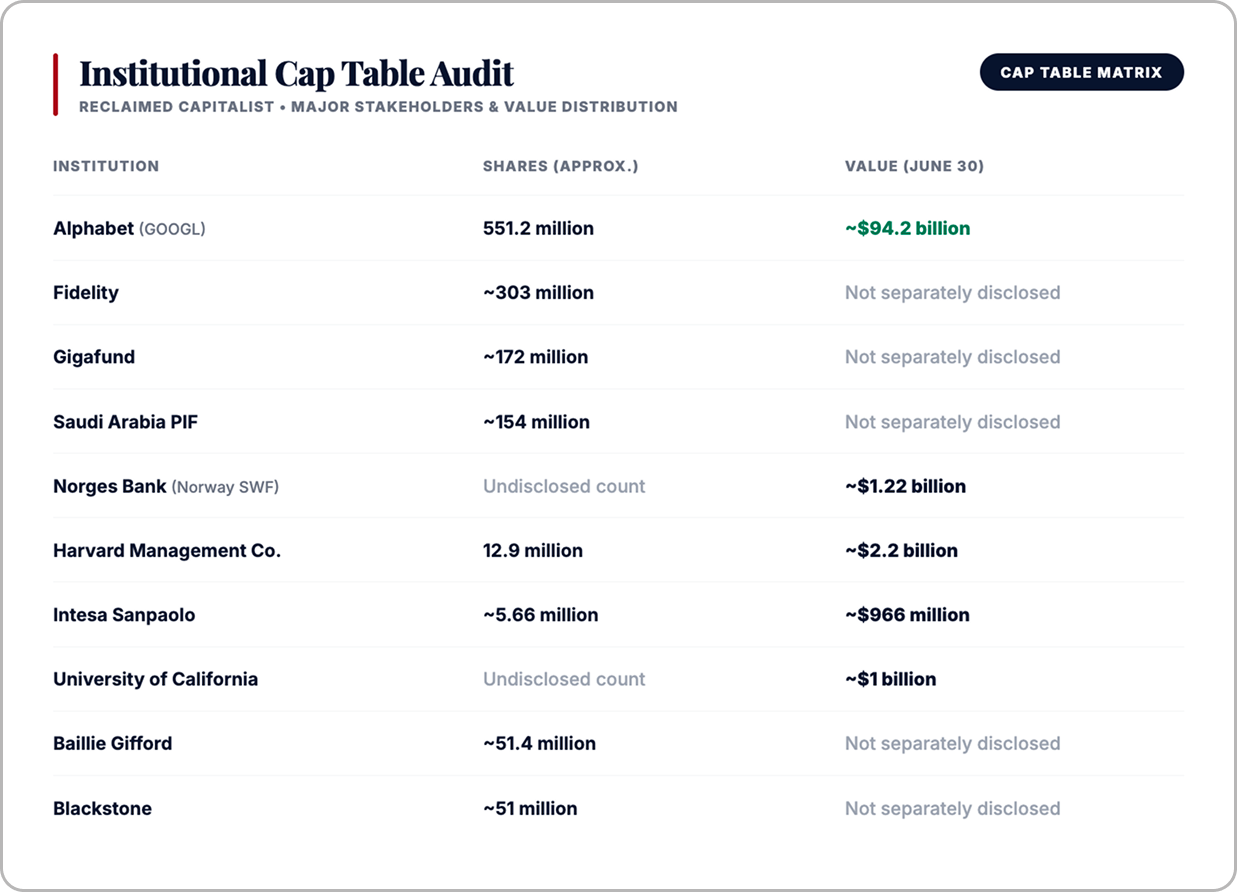
Alphabet alone controls 551.2 million shares—a position representing 5.8 times Friday's entire trading volume. That single holding grew from a $900 million strategic bet in 2015 into a $94 billion asset, delivering a 100x return over ten years.
This isn't broad, diversified market ownership. This is an unprecedented concentration of capital spanning sovereign wealth funds, mega-cap tech balance sheets, tier-one global banks, and university endowments simultaneously.
The central question for independent allocators is not whether SpaceX is a quality enterprise. The question is whether this level of institutional crowding introduces a structural fragility that public markets have failed to price.
— Sponsored Briefing —
Is This the iPhone 18 Killer?

Every year Apple releases a new iPhone.
And every year people line up to buy it.
But here’s the real question…
What if your phone actually paid you to use it?
That’s the idea behind Mode Mobile.
Instead of just scrolling, streaming, and draining your battery…
Mode’s EarnPhone rewards users for things they already do on their phones
So far the results are huge.
Users have already $1B in Earnings and Savings
The company has generated $115M in revenue and $11.8M as EBITDA and attracted 59,000+ shareholders.
Now Mode is preparing for the next stage — with a reserved Nasdaq ticker ($MODE) and plans for a potential IPO.
And right now, investors still have a rare window to participate before that happens.
Join 59,000+ shareholders before the pre-IPO offering closes.
The Corporate Weaponization
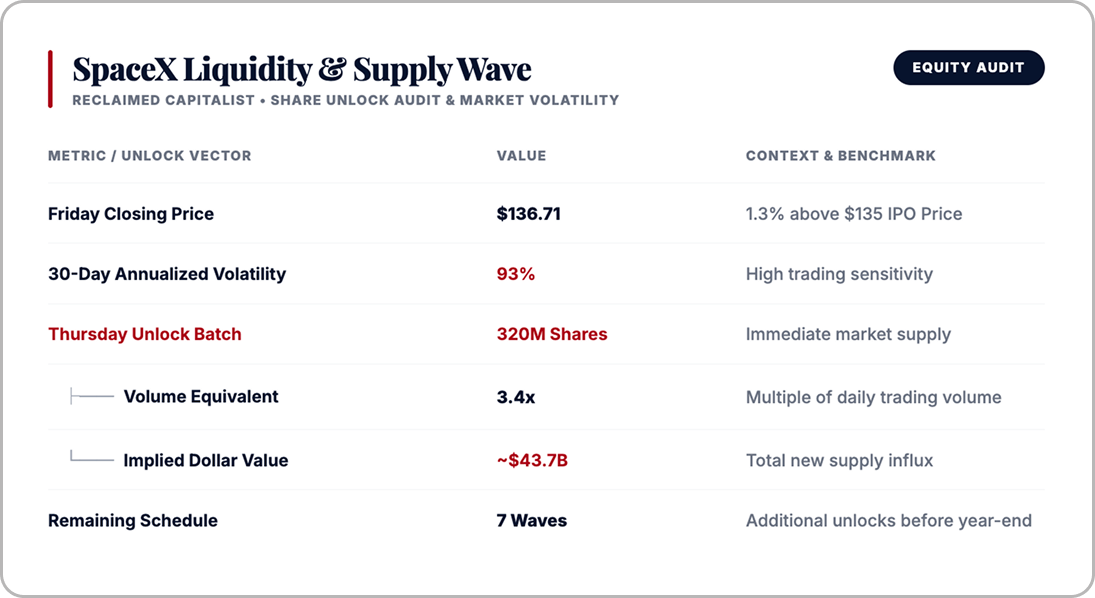
On Thursday, 320 million SpaceX shares unlock. This single batch represents 3.4 times Friday's total trading volume. At Friday's close of $136.71, that introduces roughly $43.7 billion in potential new market supply.
SpaceX closed at $136.71—a razor-thin 1.3% above its $135 IPO price. A modest weekly gain of 5.2% masked a 3.2% decline in Friday's session alone.
Crucially, there are seven additional unlock windows scheduled before year-end.
Wall Street price targets range wildly—from Stifel's $190 to Morgan Stanley's $300. Yet Morningstar pegs fair value at $780 billion (roughly half the current market cap) citing a "narrow" moat, a figure echoed by valuation expert Aswath Damodaran.
Consider the structural realities:
- Option to Sell $\neq$ Immediate Panic: An unlock does not guarantee instant selling, but it unlocks structural liquidity options for early holders.
- Rebalancing Incentives: Institutional holders sitting on 100x gains do not hold perpetually. Trimming positions is standard portfolio rebalancing, not panic selling.
- Volatility Signals: A 93% annualized volatility metric does not reflect a mature, price-stable asset. It reflects a volatile post-IPO instrument searching for fundamental price discovery.
Supply calendars and liquidity constraints dictate near-term market truth. The upcoming supply calendar for SpaceX remains a primary risk variable.
The AI Revenue Crossover: The Structural Shift Underneath the SpaceX Narrative
While media outlets obsessed over 13F filings, two critical operational data points landed on August 14 and 15 that hold far greater weight for disciplined capital allocation.
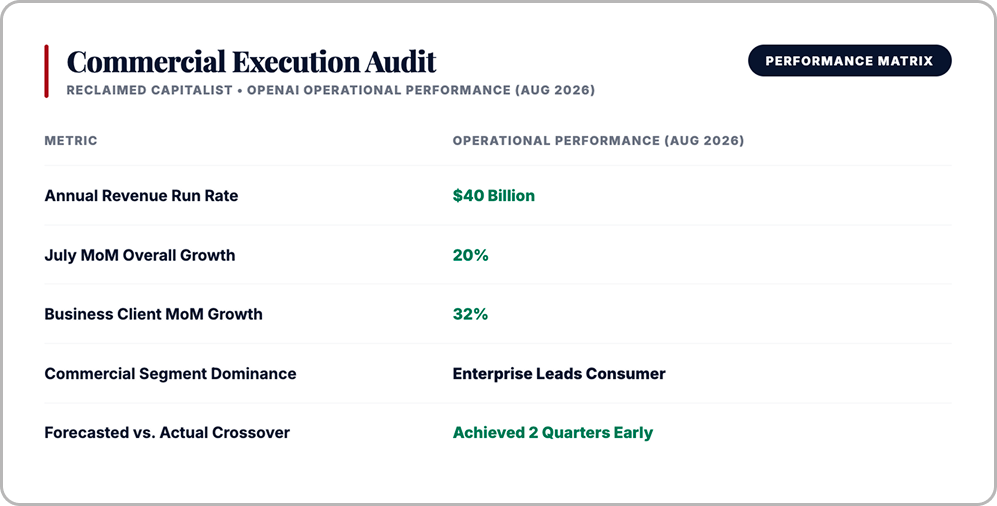
OpenAI: CFO Sarah Friar confirmed to investors that enterprise business revenue has officially surpassed consumer subscription revenue. The annual run rate crossed $40 billion, supported by 20% month-over-month growth in July and a 32% MoM surge in enterprise clients. This commercial crossover arrived roughly two quarters ahead of internal management forecasts.
Anthropic: Early Q2 2026 revenue topped $11.5 billion—a 14-fold increase year-over-year and nearly double Q1's $4.73 billion print. Crucially, this marked Anthropic's first quarter of positive adjusted operating income.
Combined, these two entities are approaching $100 billion in annualized revenue as both prepare for public listings.
The Strategic takeaway: The enterprise AI sector has transitioned from speculative adoption into a mature, cash-generating deployment phase. The structural capital layer supporting this expansion—semiconductor fabs, specialized cloud compute, and data center utilities—now rests on a verified, scaling revenue foundation.
Focus on the structural revenue layer that validates the AI buildout, rather than chasing single post-IPO equities trading at 93% volatility ahead of massive share unlocks.
— Sponsored Briefing —
Even Elon Admits Anthropic Is "The Clear Leader in AI"
Elon Musk has admitted defeat.
Just days after SpaceX's IPO, Elon made it clear he believes he is second-best.

After years of bashing them, Elon said Anthropic was "the clear leader in AI."
That's the company behind ClaudeAI and its now famous Mythos model, what many believe to be the strongest AI to date … including Elon.
"I was clearly wrong about Anthropic," Musk added. "No company has released a model as good as Mythos."
Now, Anthropic is about to go public …
Perhaps as soon as October.
The value of the company has doubled since the announcement.
Many experts think Anthropic could be worth $3 trillion by IPO day.
Google, Amazon and Nvidia are all heavily invested in this IPO.
Even Microsoft, who used to be associated with OpenAI's ChatGPT, is invested in Anthropic.
Goldman Sachs, Morgan Stanley and JPMorgan are tripping over each other to get a private stake before the IPO.
Even whole countries are invested …
Including the United Arab Emirates, Singapore and Qatar.
That's because Anthropic is a rare breed … the rarest, in fact.
You see, venture capitalists call a private company worth over a $1 billion a unicorn.
$10 billion and it's a decacorn.
$100 billion is a hectocorn.
But what do you call a private company worth over a trillion dollars?
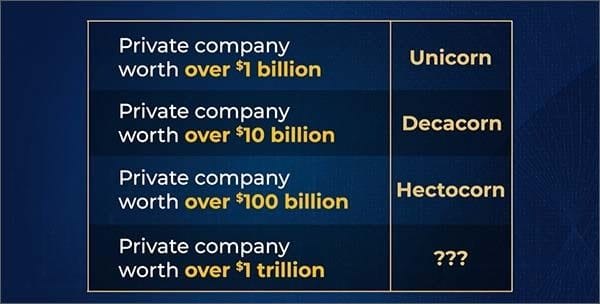
Anthropic is there, right now.
The first of its kind.
It's worth more than every American airline — combined.
It's even bigger than the U.S. defense budget …
Anthropic's annualized revenue grew by 80 times in the first quarter.
They've already filed the paperwork for an IPO …
Some estimates say they are going public as early as October.
Most analysts agree, it's going to happen sometime this fall at worst.
Now, here's what's really exciting …
You can get a stake in this company, right now.
Today.
Before it goes public.
And cash in on day one of this IPO.
I'll show you how here.
The Operational Takeaway
The Capital Reclamation Framework
Here is what this week's filings mean for your capital architecture:
- 1. Institutional Crowding Is a Legacy Signal, Not a Buy Signal: Harvard's $2.2 billion position reflects venture-stage allocations executed over a decade ago. 13F filings disclose historic positions; they do not reveal cost basis, hedging strategies, or real-time exit execution. Treating backward-looking 13F filings as current buy signals is a fundamental mistake.
- 2. Interconnected Capital Ecosystems Carry Hidden Leverage: The xAI-X transaction added $12 billion in debt to Elon Musk’s broader corporate ecosystem. Evaluating balance sheets in isolation is flawed—capital demands across linked entities (SpaceX, xAI, X, Tesla) compound structural risk.
- 3. Prioritize Revenue Proof Points Over Headline Crowding: OpenAI crossing $40B ARR two quarters early and Anthropic generating its first operating profit at $11.5B quarterly revenue are real structural shifts. Direct capital toward verified cash-flow infrastructure, not crowded legacy positions.
- 4. Respect the Supply Calendar: With 320 million shares unlocking Thursday and seven more rounds before year-end, short-term price action will be driven by supply-and-demand mechanics rather than media narrative.
The Sovereign Directive: Your capital is not a multi-billion-dollar university endowment with a 100-year horizon or a 2014 venture entry point. Your capital is a finite, sovereign asset that must generate reliable income and maintain purchasing power against persistent inflation.
Analyze through a balance-sheet lens, respect liquidity calendars, and deploy capital only where structural revenue proof supports your perimeter.
— Patrick Gibson The Reclaimed Capitalist
Disclaimer: This analysis is for educational purposes only and should not be considered investment advice. Always do your own research before making investment decisions.
Items marked with an asterisk (*) are promotional and help support this newsletter at no cost to readers.
Please read the offering circular and related risks at invest.modemobile.com . This is a paid advertisement for Mode Mobile’s Regulation A+ Offering.
Mode Mobile recently received their ticker reservation with Nasdaq ($MODE), indicating an intent to IPO in the next 24 months. An intent to IPO is no guarantee that an actual IPO will occur.
The Deloitte rankings are based on submitted applications and public company database research, with winners selected based on their fiscal-year revenue growth percentage over a three-year period.