The $40B Run-Rate Paradox: OpenAI’s C-Suite Exodus and IPO Positioning
OpenAI hits a $40B revenue run-rate while its leadership structure unwinds. Here is the operational analysis beneath the headline momentum.
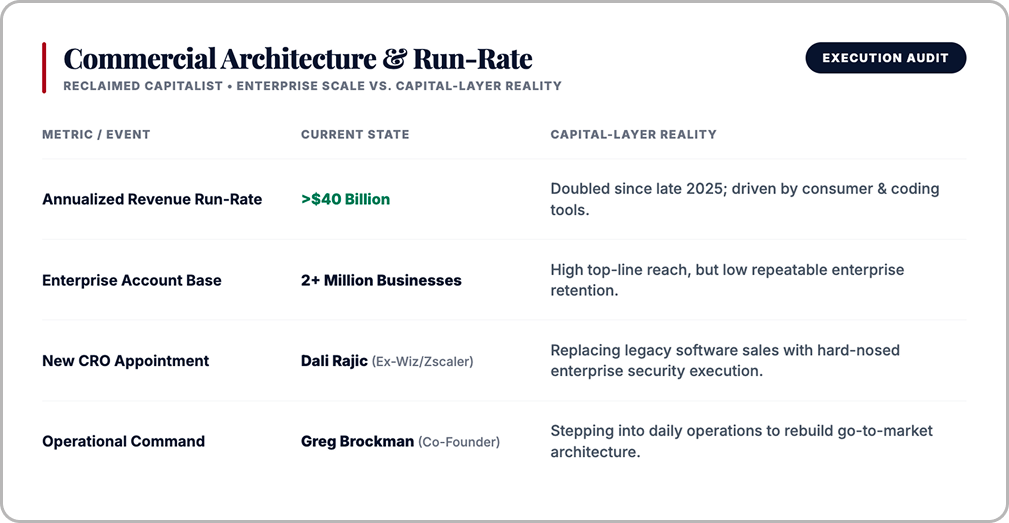
The mainstream financial press spent the morning celebrating a massive top-line milestone: OpenAI is on track to cross $40 billion in annualized revenue, effectively doubling its run-rate from late 2025. Driven by expanding ChatGPT subscriptions, enterprise deployments, and AI coding tools, the top-line narrative appears unstoppable.
That is the press release. Now look at the executive floor.
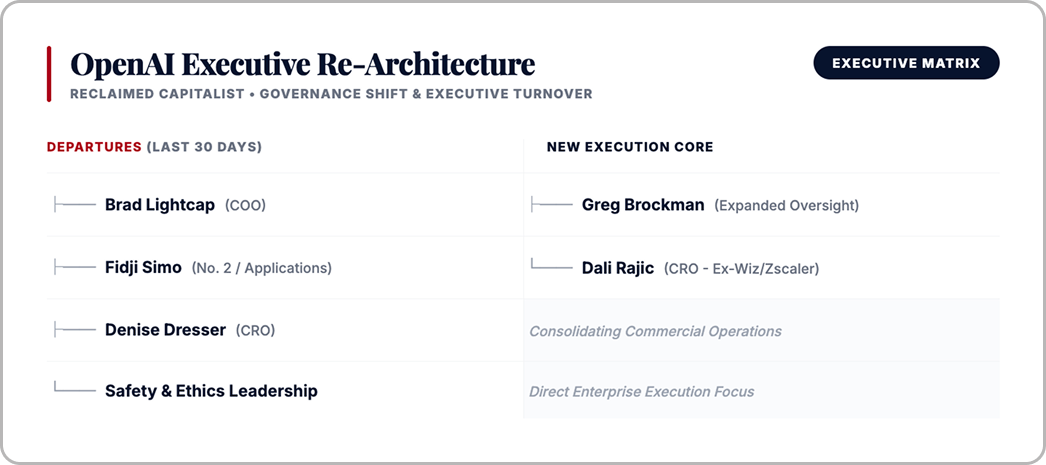
In the span of four weeks, OpenAI has experienced a sweeping C-suite exodus. Chief Operating Officer Brad Lightcap resigned after eight years. Fidji Simo, Sam Altman’s second-in-command and AGI deployment lead, stepped down. Denise Dresser, Chief Revenue Officer, departed after less than nine months on the job. They were accompanied out the door by the head of ethics, the head of safety, and the chief futurist.
When a hyper-growth enterprise doubles its revenue while shedding its operational C-suite ahead of an expected IPO, individual allocators must look beyond top-line velocity.
The core question isn't "Is revenue growing?"
The real question is: Why is the world’s most valuable AI startup completely replacing its go-to-market execution engine on the eve of a Wall Street debut?
The Intelligence Brief: Media Narrative vs. Operational Reality
Let's cut through the public relations framing and examine the structural shifts taking place behind closed doors.
What the media claims: OpenAI is experiencing normal corporate maturation as it retools its leadership team to execute a seamless confidential IPO filing.
What is actually happening at the capital layer: OpenAI is engaged in a high-stakes, direct race with Anthropic for enterprise dominance. Despite holding over 2 million corporate accounts, internal disclosures acknowledge that OpenAI has struggled with repeatable enterprise conversion and long-term retention.
Co-founder and President Greg Brockman has stepped back into direct operational management across every tier of the company. Rebuilding the sales motion from scratch while maintaining a $40 billion revenue pace is a high-wire act.
SpaceX's IPO made history. The stock hit $165 in a week.
But the most important part of this story may not be the rockets.
It's Starlink. T-Mobile just enabled Starlink satellite connectivity on every iPhone and billions of phones are coming online for the first time.
Starlink sells them the connection. That's where its job ends. But every hour those people spend on their phones generates ad revenue - and someone has to collect it.
I found the company doing it. 490 million users. A billion dollars earned and saved. 32,481% revenue growth - enough to make it the #1 software company according to Deloitte's fastest growing companies list in 2023. $11.8 million in EBITDA in 2025. And it hasn't gone public yet.
Series A open at $0.52/share.
But on August 14, the opportunity to invest at this price closes — and it's gone after that.
Every previous round sold out. I don't expect this one to last either.
The Tactical Strike: The Enterprise Battle vs. Anthropic
To understand the sudden hiring of Dali Rajic—former President and COO of cloud security giant Wiz—as the new Chief Revenue Officer, you have to look at the competitive landscape.
OpenAI is not losing consumer mindshare; it is losing ground in institutional workflows. Longtime rival Anthropic has aggressively captured enterprise market share with specialized developer tools like Claude Code and strict enterprise data-privacy frameworks.
The Consumer vs. B2B Disconnect: Consumer subscriptions and ad-supported models deliver high volume but volatile churn. Long-term public market valuations require multi-year enterprise contracts with high switching costs.
The Security-First Sales Motion: Hiring Rajic—a veteran of Zscaler, AppDynamics, and Wiz—signals that OpenAI is abandoning traditional software sales tactics in favor of a security-first, infrastructure-level enterprise sales playbook.
OpenAI has partnered with elite executive recruiting firms specifically to rebuild its entire go-to-market organization. They aren't tweaking the sales team; they are replacing it.
The Corporate Weaponization: IPO Valuation Engineering
There is a structural reason for this urgent leadership overhaul: the public market exit timeline.
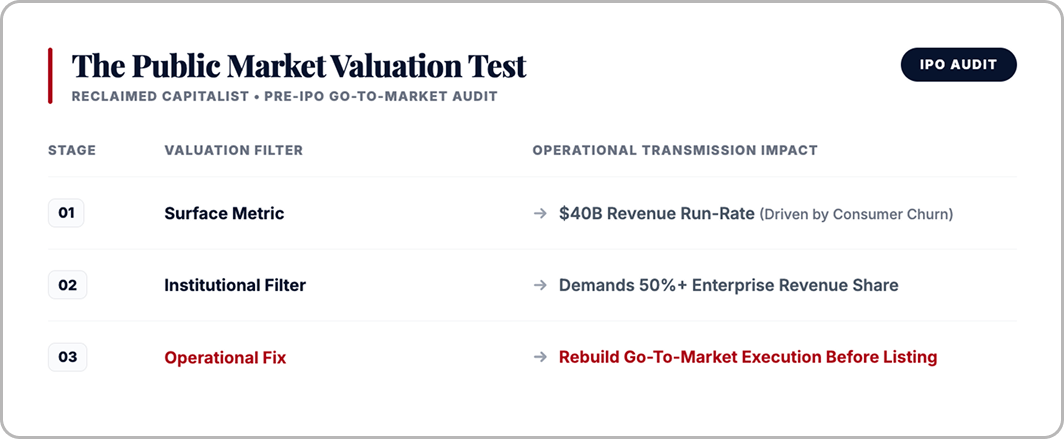
OpenAI has confidentially submitted paperwork for an initial public offering, aiming for a targeted valuation exceeding $850 billion to $1 trillion. However, Wall Street institutional desks evaluate public-bound tech firms using rigorous unit economics:
If enterprise contracts do not account for at least half of total revenue prior to listing, public market allocators will price OpenAI as a consumer media asset rather than a enterprise software monopoly. The executive turnover is the direct result of management forcing an aggressive enterprise transformation before the IPO window closes.
Editor's Note: Robert Kiyosaki, author of Rich Dad Poor Dad, the #1 personal finance book of all time with over 40 million copies sold, has spent decades teaching everyday Americans how the wealthy actually build income. He called the 2008 housing crash before it happened, warned investors to buy gold and silver well before their historic runs, and has been pounding the table on cash-flowing assets for over 30 years. Today, he'll show you an income play funded entirely by America's oil and gas infrastructure. One that's already paying some investors $25,000 a month and is the closest thing to universal basic income that may ever exist. Click here to see the details or read more below.
There are two possible paths to Universal Basic Income (UBI) in America.
Path #1: Wait for Elon Musk's robots to take over the economy, hope the government figures out how to redistribute AI-generated wealth, and pray it happens before you're 85.
Path #2: Enroll in what I call the Patriot Income Plan (P.I.P.) and start collecting 10% a year from America's oil and gas infrastructure immediately.
42 payouts a year. Deposited automatically into your account.
There are zero requirements on your end.
All you need is a photo ID, bank account, social security number, and permanent address. That's it.
One P.I.P. investor collects $4,800 a month. Another pulls in $25,000.
A guy named Weston says he collects $350,000 a year.
I can't verify these claims since they're from the wild west of the Internet.
But I don't doubt them either.
Musk has been tweeting about UBI for a decade. These investors have been collecting it.
The next P.I.P. payout is already on the calendar.
Sincerely, Robert Kiyosaki Editor, The Kiyosaki Letter
The Sovereign Directive: Tactical Portfolio Positioning
As an Individual Sovereign, you do not invest based on private-market hype or top-line run-rate announcements. You evaluate structural execution, balance sheet stability, and management continuity.
The Sovereign Execution Plan:
1. Audit High-Beta AI Exposure: Recognize that private pre-IPO valuations for mega-cap AI labs carry significant operational execution risk. Avoid chasing secondary private-market shares during periods of C-suite restructuring.
2. Track Enterprise Retention Metrics: Watch whether OpenAI’s new security-focused sales leadership successfully converts B2B pilot programs into multi-year enterprise commitments over the next two quarters.
3. Evaluate the Anthropic Moat: Monitor Anthropic's enterprise expansion speed. As both firms race toward public debuts, developer adoption and enterprise infrastructure stickiness will determine ultimate valuation multiples.
Ignore headline growth figures. Watch the operational architecture, track the C-suite transitions, and guard your capital perimeter accordingly.
— Patrick Gibson The Reclaimed Capitalist
Ivan Sulyma (Polish: Iwan Sulima, Ukrainian: Іван Михайлович Сулима – Ivan Mykhailovych Sulyma) was a Senior of Registered Cossacks in 1628–29 and a Kosh Otaman in 1630–1635.
Life and death
Son of Mykhailo Sulyma, Ivan came from a petty noble (szlachta) family. He was born in Rohoshchi (next to Chernihiv). He served as an estate overseer for Stanisław Żółkiewski and later the family of Daniłowicze who inherited his lands; for that service in 1620 he was awarded three villages: Sulimówka, Kuczakiw and Lebedyn. All the villages today belong to the Boryspil Raion, Kyiv Oblast. His sons included Stepan (died 1659), a captain of Boryspil company, and Fedir (died 1691), a colonel of Pereiaslav regiment.
He became popular among the unregistered Cossacks, leading them on campaigns to plunder Crimea and other Ottoman vassal territories. For organizing a revolt on an Ottoman slave galley and freeing Christian slaves[1] he received a medal from Pope Paul V himself. Eventually, Sulyma reached the rank of the hetman, which he held from 1628 to 1629 and 1630 to 1635.
In 1635, after returning from an expedition to Black Sea against the Ottomans, he decided to rebel against the Polish–Lithuanian Commonwealth, which at that time controlled most of the Cossack territories, and whose nobility was trying to turn militant Cossacks into serfs.[citation needed] Ivan Sulyma took part in numerous campaigns of Sagaidachny against Tatars and Turks. In particular, it was the famous capture of Kafa (modern Theodosia), the main center of the slave trade on the Black Sea, Trapezont, Izmail, and also two attacks on Tsaregrad. On the night of 3 to 4 August 1635 he took the newly constructed Kodak fortress by surprise, burning it and executing its crew of about 200 people under Jean Marion. Soon afterwards however his forces were defeated by the army of hetman Stanisław Koniecpolski and Sulima was turned over to the Commonwealth by Cossack elders or starshina. Together with several other leaders of his rebellion, Hetman Sulyma was executed in Warsaw on 12 December 1635. At first, the Polish King Władysław IV Waza, known for his friendly attitude towards the Cossacks, was hesitant to execute Sulyma, especially since he was a person upon whom the Pope himself bestowed his medal. However, pressured by the nobility who wanted to show that no rebellions against the 'established order' would be tolerated, the order for an execution was given; after being tortured, Sulyma was cut to pieces and his body parts were hung on the city walls of Warsaw.[2]
he Child
Winston Churchill was born into the privileged world of the British aristocracy on November 30, 1874. His father, Lord Randolph Churchill, was a younger son of the 7th Duke of Marlborough. His mother, Jennie Jerome, was the daughter of an American business tycoon, Leonard Jerome.
Winston’s childhood was not a particularly happy one. Like many Victorian parents, Lord and Lady Randolph Churchill were distant. The family Nanny, Mrs Everest, became a surrogate mother to Winston and his younger brother, John S Churchill.
The Soldier
After passing out of Sandhurst and gaining his commission in the 4th Hussars’ in February 1895, Churchill saw his first shots fired in anger during a semi-official expedition to Cuba later that year. He enjoyed the experience which coincided with his 21st birthday.
In 1897 Churchill saw more action on the North West Frontier of India, fighting against the Pathans. He rode his grey pony along the skirmish lines in full view of the enemy. “Foolish perhaps,” he told his mother, ” but I play for high stakes and given an audience there is no act too daring and too noble.” Churchill wrote about his experiences in his first book The Story of the Malakand Field Force (1898). He soon became an accomplished war reporter, getting paid large sums for stories he sent to the press – something which did not make him popular with his senior officers.
Using his mother’s influence, Churchill got himself assigned to Kitchener’s army in Egypt. While fighting against the Dervishes he took part in the last great cavalry charge in English history – at the Battle of Omdurman in 1898.
The Politician
Churchill was first elected to parliament in 1900 shortly before the death of Queen Victoria. He took his seat in the House of Commons as the Conservative Member for Oldham in February 1901 and made his maiden speech four days later. But after only four years as a Conservative he crossed the floor and joined the Liberals, making the flamboyant gesture of sitting next to one of the leading radicals, David Lloyd George.
Churchill rose swiftly within the Liberal ranks and became a Cabinet Minister in 1908 – President of the Board of Trade. In this capacity and as Home Secretary (1910-11) he helped to lay the foundations of the post-1945 welfare state.
His parliamentary career was far from being plain sailing and he made a number of spectacular blunders, so much so that he was often accused of having genius without judgement. The chief setback of his career occurred in 1915 when, as First Lord of the Admiralty, he sent a naval force to the Dardanelles in an attempt to knock Turkey out of the war and to outflank Germany on a continental scale. The expedition was a disaster and it marked the lowest point in Churchill’s fortunes.
However, Churchill could not be kept out of power for long and Lloyd George, anxious to draw on his talents and to spike his critical guns, soon re-appointed him to high office. Their relationship was not always a comfortable one, particularly when Churchill tried to involve Britain in a crusade against the Bolsheviks in Russia after the Great War.
Between 1922 and 1924 Churchill left the Liberal Party and, after some hesitation, rejoined the Conservatives. Anyone could “rat”, he remarked complacently, but it took a certain ingenuity to “re-rat”. To his surprise, Churchill was appointed Chancellor of the Exchequer by Stanley Baldwin, an office in which he served from 1924 to 1929. He was an ebullient if increasingly anachronistic figure, returning Britain to the Gold Standard and taking an aggressive part in opposing the General Strike of 1926.
After the Tories were defeated in 1929, Churchill fell out with Baldwin over the question of giving India further self-government. Churchill became more and more isolated in politics and he found the experience of perpetual opposition deeply frustrating. He also made further blunders, notably by supporting King Edward VIII during the abdication crisis of 1936. Largely as a consequence of such errors, people did not heed Churchill’s dire warnings about the rise of Hitler and the hopelessness of the appeasement policy. After the Munich crisis, however, Churchill’s prophecies were seen to be coming true and when war broke out in September 1939 Prime Minister Neville Chamberlain appointed him First Lord of the Admiralty. So, nearly twenty-five years after he had left the post in pain and sorrow, the Navy sent out a signal to the Fleet: “Winston is back”.
The War Leader
For the first nine months of the conflict, Churchill proved that he was, as Admiral Fisher had once said, “a war man”. Chamberlain was not. Consequently the failures of the Norwegian Campaign were blamed on the pacific Prime Minister rather than the belligerent First Lord, and, when Chamberlain resigned after criticisms in the House of Commons, Churchill became leader of a coalition government. The date was May 10, 1940: it was Churchill’s, as well as Britain’s, finest hour.
When the German armies conquered France and Britain faced the Blitz, Churchill embodied his country’s will to resist. His oratory proved an inspiration. When asked exactly what Churchill did to win the war, Clement Attlee, the Labour leader who served in the coalition government, replied: “Talk about it.” Churchill talked incessantly, in private as well as in public – to the astonishment of his private secretary, Jock Colville, he once spent an entire luncheon addressing himself exclusively to the marmalade cat.
Churchill devoted much of his energy to trying to persuade President Roosevelt to support him in the war. He wrote the President copious letters and established a strong personal relationship with him. And he managed to get American help in the Atlantic, where until 1943 Britain’s lifeline to the New World was always under severe threat from German U-Boats.
Despite Churchill’s championship of Edward VIII, and despite his habit of arriving late for meetings with the neurotically punctual King at Buckingham Palace, he achieved good relations with George VI and his family. Clementine once said that Winston was the last surviving believer in the divine right of kings.
As Churchill tried to forge an alliance with the United States, Hitler made him the gift of another powerful ally – the Soviet Union. Despite his intense hatred of the Communists, Churchill had no hesitation in sending aid to Russia and defending Stalin in public. “If Hitler invaded Hell,” he once remarked, “I would at least make a favourable reference to the Devil in the House of Commons.”
In December 1941, six months after Hitler had invaded Russia, Japan attacked Pearl Harbor. The war had now become a global one. But with the might of America on the Allied side there could be no doubt about its outcome. Churchill was jubilant, remarking when he heard the news of Pearl Harbor: “So we have won after all!”
However, America’s entry into the war also caused Churchill problems; as he said, the only thing worse than fighting a war with allies is fighting a war without them. At first, despite disasters such as the Japanese capture of Singapore early in 1942, Churchill was able to influence the Americans. He persuaded Roosevelt to fight Germany before Japan, and to follow the British strategy of trying to slit open the “soft underbelly” of Europe. This involved the invasions of North Africa, Sicily, and Italy – the last of which proved to have a very well armoured belly.
It soon became apparent that Churchill was the littlest of the “Big Three”. At the Teheran Conference in November, 1943, he said, the “poor little English donkey” was squeezed between the great Russian bear and the mighty American buffalo, yet only he knew the way home.
In June 1944 the Allies invaded Normandy and the Americans were clearly in command. General Eisenhower pushed across Northern Europe on a broad front. Germany was crushed between this advance and the Russian steamroller. On May 8, 1945 Britain accepted Germany’s surrender and celebrated Victory in Europe Day. Churchill told a huge crowd in Whitehall: “This is your victory.” The people shouted: “No, it is yours”, and Churchill conducted them in the singing of Land of Hope and Glory. That evening he broadcast to the nation urging the defeat of Japan and paying fulsome homage to the Crown.
From all over the world Churchill received telegrams of congratulations, and he himself was generous with plaudits, writing warmly to General de Gaulle whom he regarded as an awkward ally but a bastion against French Communism. But although victory was widely celebrated throughout Britain, the war in the Far East had a further three months to run. The atomic bombing of Hiroshima and Nagasaki finally brought the global conflict to a conclusion. But at the pinnacle of military victory, Churchill tasted the bitterness of political defeat.
The Elder Statesman
Churchill expected to win the election of 1945. Everything pointed to his victory, from the primitive opinion polls to the cartoons in newspapers and the adulation Churchill received during the campaign, but he did not conduct it well. From the start he accused the Labour leaders – his former colleagues – of putting party before country and he later said that Socialists could not rule without a political police, a Gestapo. As it happened, such gaffes probably made no difference. The political tide was running against the Tories and towards the party which wholeheartedly favoured a welfare state – the reward for war-time sacrifices. But Churchill was shocked by the scale of his defeat. When Clementine, who wanted him to retire from politics, said that it was perhaps a blessing in disguise, Churchill replied that the blessing was certainly very effectively disguised. For a time he lapsed into depression, which sympathetic letters from friends did little to dispel.
Soon, however, Churchill re-entered the political arena, taking an active part in political life from the opposition benches and broadcasting again to the nation after the victory over Japan. In defeat Churchill had always been defiant, but in victory he favoured magnanimity. Within a couple of years he was calling for a partnership between a “spiritually great France and a spiritually great Germany” as the basis for the re-creation of “the European family”. He was more equivocal about Britain’s role in his proposed “United States of Europe”, and, while the embers of the World War II were still warm, he announced the start of the Cold War. At Fulton, Missouri, in 1946, he pointed to the new threat posed by the Soviet Union and declared that an iron curtain had descended across Europe. Only by keeping the alliance between the English-speaking peoples strong, he maintained, could Communist tyranny be resisted.
After losing another election in 1950, Churchill gained victory at the polls the following year. Publicly he called for “several years of quiet steady administration”. Privately he declared that his policy was “houses, red meat and not getting scuppered”. This he achieved. But after suffering a stroke and the failure of his last hope of arranging a Summit with the Russians, he resigned from the premiership in April 1955.
“I am ready to meet my Maker,” Churchill had said on his seventy-fifth birthday; “whether my Maker is prepared for the great ordeal of meeting me is another matter”. Churchill remained a member of parliament, though an inactive one, and announced his retirement from politics in 1963. This took effect at the general election the following year. Churchill died on 24 January 1965 – seventy years to the day after the death of his father. He received the greatest state funeral given to a commoner since that of the Duke of Wellington. He was buried in Bladon churchyard beside his parents and within sight of his birthplace, Blenheim Palace.
The Family Man
In the autumn of 1908 Churchill, then a rising Liberal politician, married Clementine Hozier, granddaughter of the 10th Earl of Airlie. Their marriage was to prove a long and happy one, though there were often quarrels – Clementine once threw a dish of spinach at Winston (it missed). Clementine was high principled and highly strung; Winston was stubborn and ambitious. His work invariably came first, though, partly as a reaction against his own upbringing, he was devoted to his children.
Winston and Clementine’s first child, Diana, was born in 1909. Diana was a naughty little girl and continued to cause her parents great distress as an adult. In 1932 she married John Bailey, but the marriage was unsuccessful and they divorced in 1935. In that year she married the Conservative politician, Duncan Sandys, and they had three children. That marriage also proved a failure. Diana had several nervous breakdowns and in 1963 she committed suicide.
The Churchills’ second child and only son, Randolph, was born in 1911. He was exceptionally handsome and rumbustious, and his father was very ambitious for him. During the 1930s Randolph stood for parliament several times but he failed to get in, being regarded as a political maverick. He did serve as Conservative Member of Parliament for Preston between 1940 and 1945, and ultimately became an extremely successful journalist and began the official biography of his father during the 1960s.
Randolph was married twice, first in 1939 to Pamela Digby (later Harriman) by whom he had a son, Winston, and secondly in 1948 to June Osborne by whom he had a daughter, Arabella. Neither marriage was a success.
The life of Sarah, the Churchills’ third child, born in 1914, was no happier than that of her elder siblings. Amateur dramatics at Chartwell led her to take up a career on the stage which flourished for a time. Sarah’s charm and vitality were also apparent in her private life, but her first two marriages proved unsuccessful and she was widowed soon after her third. Her first husband was a music hall artist called Vic Oliver whom she married against her parents’ wishes. Her second was Anthony Beauchamp but this marriage did not last and after their separation he committed suicide.
In 1918 Clementine Churchill gave birth to a third girl, Marigold. But in 1921, shortly after the deaths of both Clementine’s brother and Winston’s mother, Marigold contracted septicaemia whilst on a seaside holiday with the childrens’ governess. When she died Winston was grief-stricken and, as his last private secretary recently disclosed in an autobiography, Clementine screamed like an animal undergoing torture.
The following September the Churchills’ fifth and last child, Mary, was born. Unlike her brother and older sisters, Mary was to cause her parents no major worries. Indeed she was a constant source of support, especially to her mother. In 1947 she married Christopher Soames; who was then Assistant Military Attaché in Paris and later had a successful parliamentary and diplomatic career. Theirs was to be a long and happy marriage. Over the years Christopher became a valued confidant and counsellor to his father-in-law. They had five children, the eldest of whom (Nicholas) became a prominent member of the Conservative party. Christopher Soames died in 1987.
The Private Man
Churchill’s enormous reserves of energy and his legendary ability to exist on very little sleep gave him time to pursue a wide variety of interests outside the world of politics.
Churchill loved gambling and lost what was, for him, a small fortune in the great crash of the American stock market in October 1929, causing a severe setback to the family finances. But he continued to write as a means of maintaining the style of life to which he had always been accustomed. Apart from his major works, notably his multi-volume histories of the First and Second World Wars and the Life of his illustrious ancestor John, first Duke of Marlborough, he poured forth speeches and articles for newspapers and magazines. His last big book was the History of the English-Speaking Peoples, which he had begun in 1938 and which was eventually published in the 1950s. In 1953 Churchill was awarded the Nobel Prize for Literature.
Churchill took up painting as an antidote to the anguish he felt over the Dardanelles disaster. Painting became a constant solace and preoccupation and he rarely spent a few days away from home without taking his canvas and brushes. Even during his tour of France’s Maginot Line in the middle of August 1939 Churchill managed to snatch a painting holiday with friends near Dreux.
In the summer of 1922, while on the lookout for a suitable country house, Churchill caught sight of a property near Westerham in Kent, and fell instantly in love with it. Despite Clementine’s initial lack of enthusiasm for the dilapidated and neglected house, with its overgrown and seemingly unmanageable grounds, Chartwell was to become a much-loved family home. Clementine, however, never quite overcame her resentment of the fact that Winston had been less than frank with her over the buying of Chartwell, and from time to time her feelings surfaced.
With typical enthusiasm, Churchill personally undertook many major works of construction at Chartwell such as a dam, a swimming pool, the building (largely with his own hands) of a red brick wall to surround the vegetable garden, and the re-tiling of a cottage at the bottom of the garden. In 1946 Churchill bought a farm adjoining Chartwell and subsequently derived much pleasure, though little profit, from farming.
Churchill was born into the world of hunting, shooting and fishing and throughout his life they were to prove spasmodic distractions. But it was hunting and polo, first learned as a young cavalry officer in India, that he enjoyed most of all.
In the summer of 1949, Churchill embarked on a new venture – he bought a racehorse. On the advice of Christopher Soames, he purchased a grey three-year-old colt, Colonist II. It was to be the first of several thoroughbreds in his small stud. They were registered in Lord Randolph’s colours – pink with chocolate sleeves and cap. (These have been adopted as the colours of Churchill College.) Churchill was made a member of the Jockey Club in 1950, and greatly relished the distinction.
Among Winston’s closest friends were Professor Lindemann and the “the three B’s” (none popular with Clementine), Birkenhead, Beaverbook, Bracken. The Churchills entertained widely, including among their guests Charlie Chaplin, Albert Einstein and Lawrence of Arabia. Churchill regularly holidayed with rich friends in the Mediterranean, spending several cruises in the late 1950s as the guest of Greek millionaire shipowner, Aristotle Onassis.
Editorial note
Much of the information presented here was originally compiled by Josephine Sykes, Monica Halpin and Victor Brown. It was edited by Allen Packwood.
Disclaimer: This analysis is for educational purposes only and should not be considered investment advice. Always do your own research before making investment decisions.
Items marked with an asterisk (*) are promotional and help support this newsletter at no cost to readers.
Mode Mobile recently received their ticker reservation with Nasdaq ($MODE), indicating an intent to IPO in the next 24 months. An intent to IPO is no guarantee that an actual IPO will occur.
The Deloitte rankings are based on submitted applications and public company database research, with winners selected based on their fiscal-year revenue growth percentage over a three-year period.