
What does Warren Buffett know that we don’t?
Why has he plunked down $40 billion into this sector...
What does Buffett know that we don't?
Why has he plunked down $40 billion into this sector...
Is it because this one stock could quietly fund your retirement?
It's not a flashy AI company.
It's not a tech startup.
But Elon Musk says civilization would crumble without their work.
And right now, it's making so much money they're paying a near 8% dividend - even during this market crash!
Starting as soon as next week...
You have the opportunity to get in on this undervalued "tarrif-proof" play.
Click here to discover what we're calling "the last retirement stock you'll ever need." >>>
This same investment is already being backed by Morgan Stanley, Goldman Sachs, and J.P. Morgan. Don't miss your shot to get in while it's still cheap >>>
(ad)
Decoding the Oracle: The Capital Architecture of Warren Buffett
For individual allocators seeking long-term compound growth, the modern financial landscape often resembles a casino. High-frequency algorithms drive intraday volatility, software companies trade at speculative multiples, and momentum-chasing crowds aggressively buy every short-term dip.
Yet, overlooking the noise stands the most successful capital compounding operation in economic history: Berkshire Hathaway. Under the leadership of Warren Buffett, Berkshire converted from a dying New England textile mill into a massive $1.08 trillion global holding entity.
From 1965 through the mid-2020s, Berkshire achieved an astonishing 19.8% compound annual growth rate (CAGR), nearly doubling the 10.2% annualized return of the S&P 500 over the same span. As of July 2026, with Berkshire's Class A shares trading near $756,000 and Class B shares resting at $495.96, Buffett’s personal net worth is valued at $147.8 billion, making him a pillar of global wealth.
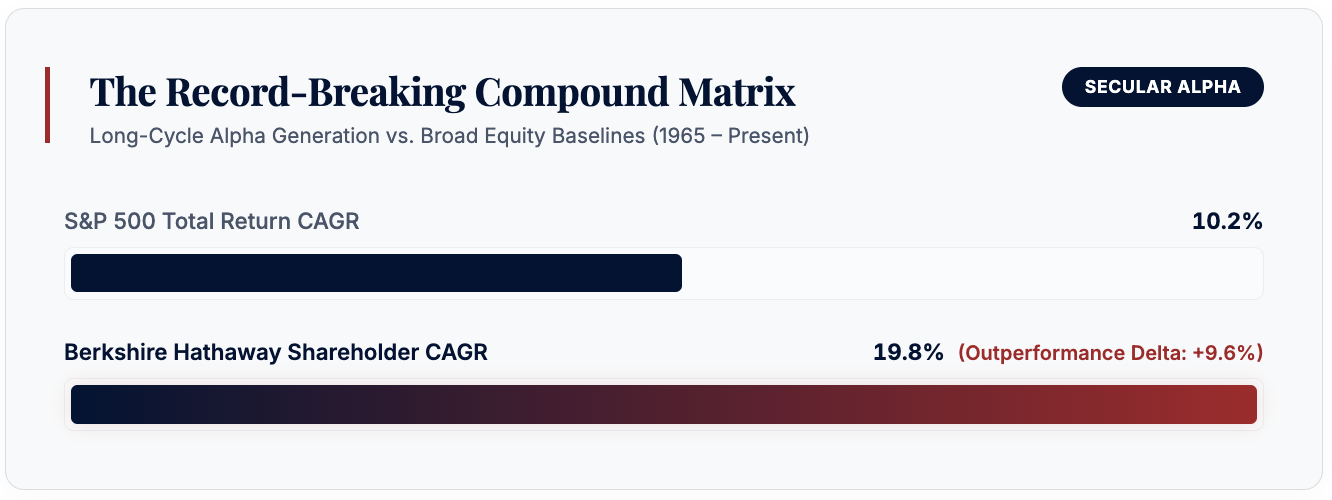
This performance is not an accident of market momentum, nor is it the result of speculative trading loops. It is the output of a highly disciplined, multi-decade capital deployment model designed to harvest arbitrage, optimize float, and systematically acquire structural monopolies.
Let's dissect the raw mechanics behind how the Oracle of Omaha built his fortress.
In partnership with Brownstone Research
Tesla Drives With No One in Control
This Tesla Demo Shocks Everyone
"Hi, I'm Jeff Brown...I'm about to get in this Tesla and let it take me a few miles to show you Elon Musk's next Big Project today…
What happens next will shock you…"

Click here to see what happened.
Early Allocation: From Arbitrage to the Benjamin Graham Framework
Warren Buffett did not begin his career with an institutional balance sheet; he began at the micro-layer, running fundamental arbitrage plays before he even reached voting age.
Born in Omaha, Nebraska, in 1930, Buffett engaged in high-velocity retail operations early on—purchasing six-packs of Coca-Cola for 25 cents and reselling individual bottles for a nickel each (a 20% gross margin), refurbishing pinball machines to lease to local barber shops, and operating paper routes. By the time he graduated college, his paper routes and vending ventures had generated over $10,000 in seed capital (adjusted for inflation, over $120,000 today).
The structural pivot occurred at Columbia Business School, where Buffett encountered Benjamin Graham, the co-author of Security Analysis and the pioneer of value investing. Graham provided the young allocator with an unyielding mathematical framework based on three pillars:
- The Margin of Safety: Never buy an asset based on speculative forward growth. Calculate its intrinsic asset value based on liquidation metrics or trailing cash flow. Purchase the asset only when the market offers a deep discount to that number, creating a buffer against operational errors.
- The "Mr. Market" Analogy: Treat daily stock market quotations as an emotional, manic-depressive business partner. If he quotes an absurdly high price, sell to him; if he panics and names a fire-sale valuation, buy from him. Never let his price fluctuations dictate your internal estimate of value.
- Net-Current-Asset Value ("Cigar Butts"): Buying companies trading below their net liquidation value (current assets minus total liabilities). Buffett labeled this the "cigar-butt" method—a soggy, discarded cigarette found on the street that offers one final, free puff of cash flow before burning out completely.
Armed with this philosophy, Buffett returned to Omaha and launched Buffett Partnership Ltd. in 1956 with $105,100 of pooled capital, of which only $100 was his own money. Over the next thirteen years, he executed net-current-asset plays with absolute mechanical discipline, compounding the partnership’s capital at an annualized rate of 29.5% without a single losing year, before voluntarily winding down the fund in 1969 because the broader markets had become overvalued.
Trump’s Bold Plan: Can He End the Ukraine War in 24 Hours? (Ad)
The Berkshire Mistake and the Insurance Float Machine
In 1962, Buffett began accumulation phases in a struggling textile manufacturer named Berkshire Hathaway, acquiring stock for his partnership at a cost basis of $7.50 per share. His initial operational thesis was purely Graham-centric: the business was closing textile mills and using the freed liquidity to buy back its own shares. Buffett planned to wait for the next tender offer, sell his equity back at a profit, and move on.
However, in 1964, Berkshire's manager, Seabury Stanton, orally agreed to buy back Buffett's stake for $11.50 per share. When the formal written tender offer arrived, it was lowered to $11.375 per share. Infuriated by the 12.5-cent bait-and-switch, Buffett refused to tender the shares. Instead, he bought aggressive control of the stock, fired Stanton, and took over the company.
Buffett later called this emotional purchase his "$200 billion mistake," as he had tied up enormous capital in a dying domestic textile business. However, it forced him to invent the master architectural blueprint of his empire: the institutional use of insurance float.
In March 1967, recognizing that textiles were a structural drag, Buffett diverted Berkshire’s capital to purchase National Indemnity Company for $8.6 million. This single transaction altered the trajectory of the firm by entering the insurance underwriting industry.
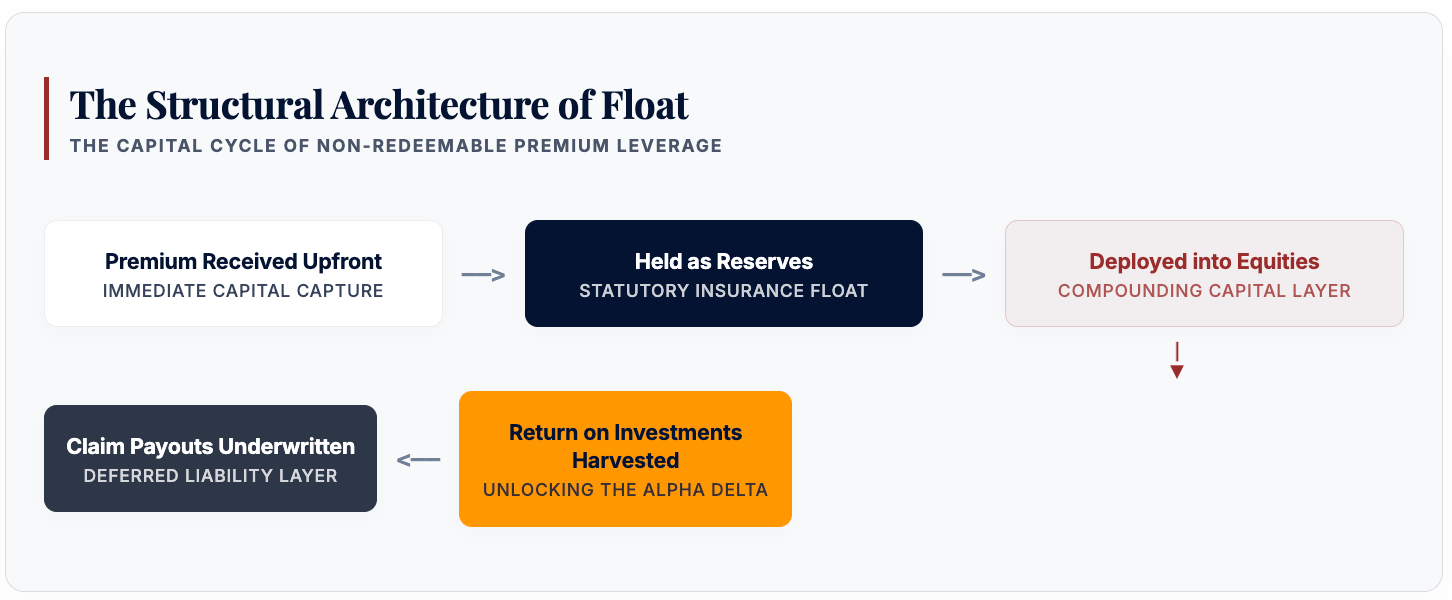
In a standard corporate setup, capital expenditure must be funded by either issuing debt or diluting equity. Insurance, however, generates float—premiums collected from policyholders upfront that are held in reserve to pay out potential claims years down the road.
Because Berkshire’s insurers underwrote risks with strict actuarial discipline, they frequently generated an underwriting profit. This meant Buffett was effectively being paid to hold billions of dollars of other people's money. He took this cost-free, non-dilutive liquidity and deployed it straight into high-yielding public equities and whole corporate acquisitions. Over fifty years, Berkshire’s available float expanded from $39 million in 1970 to over $160 billion, creating an internal capital flywheel unmatched anywhere else on Wall Street.
Shifting the Architecture: Charlie Munger and Moat Expansion
While Benjamin Graham taught Buffett how to buy cheap assets, it was his long-time business partner, Charlie Munger, who forced the evolution to his ultimate investment playbook: buying outstanding businesses at fair prices, rather than fair businesses at outstanding prices.
Munger helped Buffett realize that a cheap, low-quality business requires constant management attention and reinvestment just to stay alive. Conversely, a high-quality business possesses an economic moat—a structural competitive advantage (such as a dominant brand, high switching costs, or low-cost production channels) that protects its market share from aggressive competitors.
The classic operational application of this thesis was Berkshire’s 1972 acquisition of See’s Candies for $25 million. See’s was a regional confectionery brand in California with modest physical assets, but it possessed massive consumer pricing power. Customers would willingly pay a premium for See’s because of its brand cachet, allowing the company to raise prices annually without destroying unit volume.
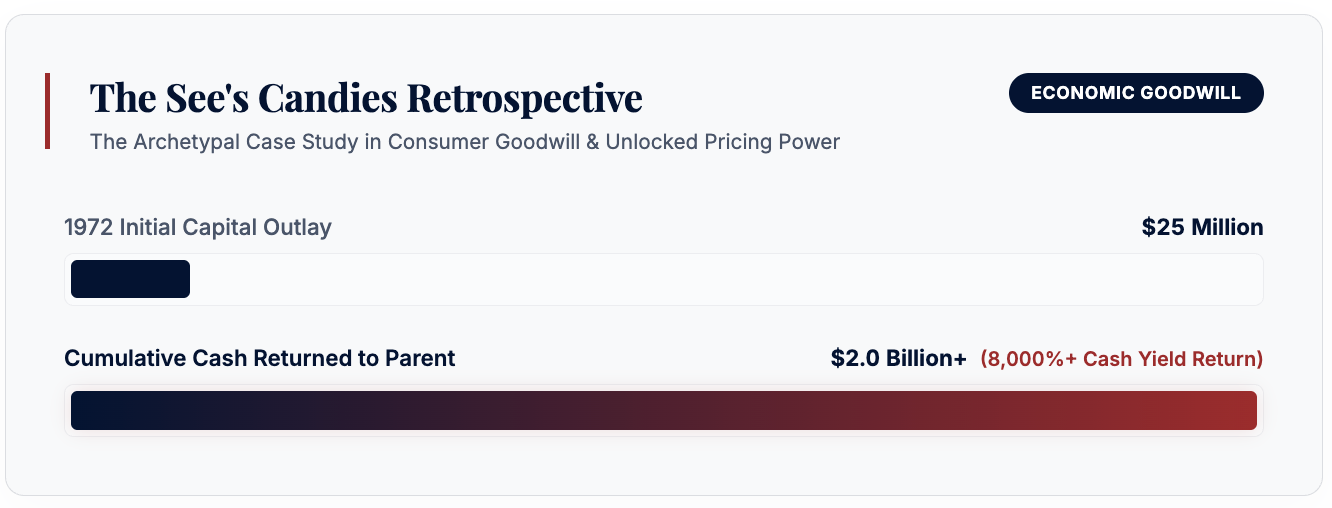
By 2019, that original $25 million investment had quietly generated
over $2 billion in cumulative cash flow for Berkshire Hathaway, providing Buffett with a continuous stream of capital to fund subsequent mega-cap acquisitions.
This moat-focused blueprint dictated Berkshire’s most iconic allocations:
- GEICO: First initialized in 1976 during a period of financial distress, Buffett realized that GEICO's direct-to-consumer model bypassed traditional insurance brokers, cementing a permanent low-cost advantage that competitors could not match.
- The Coca-Cola Company: Following the 1987 crash, Buffett deployed $1.3 billion of Berkshire's float to capture 7% of Coca-Cola's equity. He reasoned that the global mindshare of the brand, coupled with an unmatched worldwide bottling network, made the company an unassailable consumer monopoly.
- Apple Inc.: Entering the equity register in 2016, Berkshire treated Apple not as a speculative hardware stock, but as an indispensable consumer utility with massive switching costs and a highly captive software ecosystem.
The Sovereign Directive: Reclaiming Your Compounding Engine
The financial press frequently attempts to humanize Warren Buffett as a folksy grandfather figure dispensing homespun wisdom from Omaha. Independent allocators must discard that narrative. Buffett is a highly precise, cold-calculating capital allocator who structured an empire designed to exploit structural market cracks, leverage structural liquidity, and compound wealth across multiple generation cycles.
As we navigate the volatility of the mid-2020s macro environment, the lessons from Buffett's multi-decade run form an essential framework for protecting your own private capital perimeter:
- Treat Equity as a Fractional Ownership Piece: Discard the speculative habit of treating stock tickers as casino tokens to be flipped for a short-term trade. If you would not feel secure owning the entire enterprise as a private operator for ten years under a total market blackout, do not own a single share for ten minutes.
- Isolate Your Structural Moat: Look for enterprises throwing off verifiable, consistent free cash flow backed by an ironclad operational perimeter—high switching costs, pricing power that outpaces core inflation, and minimal capital expenditure requirements.
- Leverage Fixed-Duration Stability: Buffett never built his empire using short-term margin borrowing or variable prime broker credit facilities. His allocation machine is anchored to premium float and long-term capital lines that are entirely immune to sudden liquidity contractions or unexpected margin calls.
The market will continue to cycle through phases of manic expansion and sudden deleveraging shocks. Do not bet your net worth on the duration of the herd's momentum. Anchor your allocation models to structural margin safety, master your own compounding engine, and secure your perimeter accordingly.
— Patrick Gibson The Reclaimed Capitalist
In partnership with Weiss Ratings
Here is my 6-step plan to protect your wealth in times of chaos
Buy?
Sell?
Hold?
If you have no idea what to do in this market, don’t worry …
No one else does either.
We have entered an Age of Chaos.
We live in uncharted territory, and the so-called "experts" on Wall Street are totally confused.
But I have a simple, six-step plan to help you protect your wealth in the chaos.
My name is Martin Weiss.
And not only have I lived through the market’s ups and downs — in fact, I’ve predicted most of them — including the savings and loan crisis, the Dot-Com Bust and the 2008 financial crisis.
The ratings system I built accurately predicted 98.3% of all banks to fail during that tumultuous time.
But I’ve also lived large portions of my life in Brazil.
I’ve experienced military coups …
Rapid inflation …
Replacement currencies …
Martial law and tanks in the streets …
So, I’ve seen a thing or two.
And in times of chaos, I always go back to a few key principles that have helped me not only survive but thrive — even when there’s literally blood in the streets.
That’s why I’m bringing you this message now.
For the last couple of years, I’ve been enjoying a well-earned retirement — here on my farm in Brazil.
I spend a lot of time swimming. And visiting with my family.
But the last few months have awakened my fiduciary duty. Because investors are confused — even desperate.
And I have the tools to help them.
So, I’ve come out of retirement to send you this critically urgent message.
We are living in an Age of Chaos.
And if you’re near my age, this could be the investing world we live in for the rest of our days.
You need to be prepared.
That’s why I’m sharing my critical, six-step chaos plan with a select group of investors — completely free.
Just watch this video to learn more.
Good luck and God bless!
Martin D. Weiss, PhD
Weiss Ratings Founder
You can also like:
- Trump’s new tech bill could put quadrillions (ad)
- Annual Economic Report 2026 (BIS)
- The $15 Gold Fund That Pays Up to $1,152/Month (from Investors Alley)
- Ford rehires ‘gray beard’ engineers after AI falls short (TechCrunch)
- Footage reveals Nvidia’s secret robot breakthrough (ad)
Disclaimer: This analysis is for educational purposes only and should not be considered investment advice. Always do your own research before making investment decisions.
Items marked with an asterisk (*) are promotional and help support this newsletter at no cost to readers.