
Why the midterm elections could be a buying opportunity for investors

Sixty percent of consumers cite inflation as their top concern. Insiders are already out.
A clear pattern repeats in the capital markets. It shows up with the same rhythm as a quarterly earnings cycle. It is not theory. It is not guesswork. It is backed by data from 31 midterm elections since 1900.
Here is the pattern: political noise pushes equity returns down before the vote. Once the noise clears, capital reprices sharply upward.
U.S. Bank Asset Management confirms the math. In the 12 months before midterms, the S&P 500 has averaged a 2.9% return. That trails the 8.9% average for all other years. In the 12 months after the vote, the figure jumps to 12.4%.
LGT's research backs the same finding. The median S&P 500 return in a midterm year is roughly half that of other years. This dip is not random. It is built into the cycle.
Meanwhile, corporate insiders are not sitting still. Streamlinefeed reports that U.S. insiders sold a massive $77.6 billion in stock during the first half of 2026. That is a 20% jump year-over-year. It is the fastest pace of insider selling since 2021.
I have seen this playbook run from inside the boardroom. Executives do not sell at record pace because they feel good. They sell because they see forward guidance, margin pressure, and stretched valuations that the retail layer does not.
This memo breaks down the full picture and marks the window that matters.
The Intelligence Brief: What the Data Actually Shows
The mainstream press frames the 2026 midterms as a political drama. It is not. It is a capital repricing event with a proven track record.
Here are the core data points in one table.
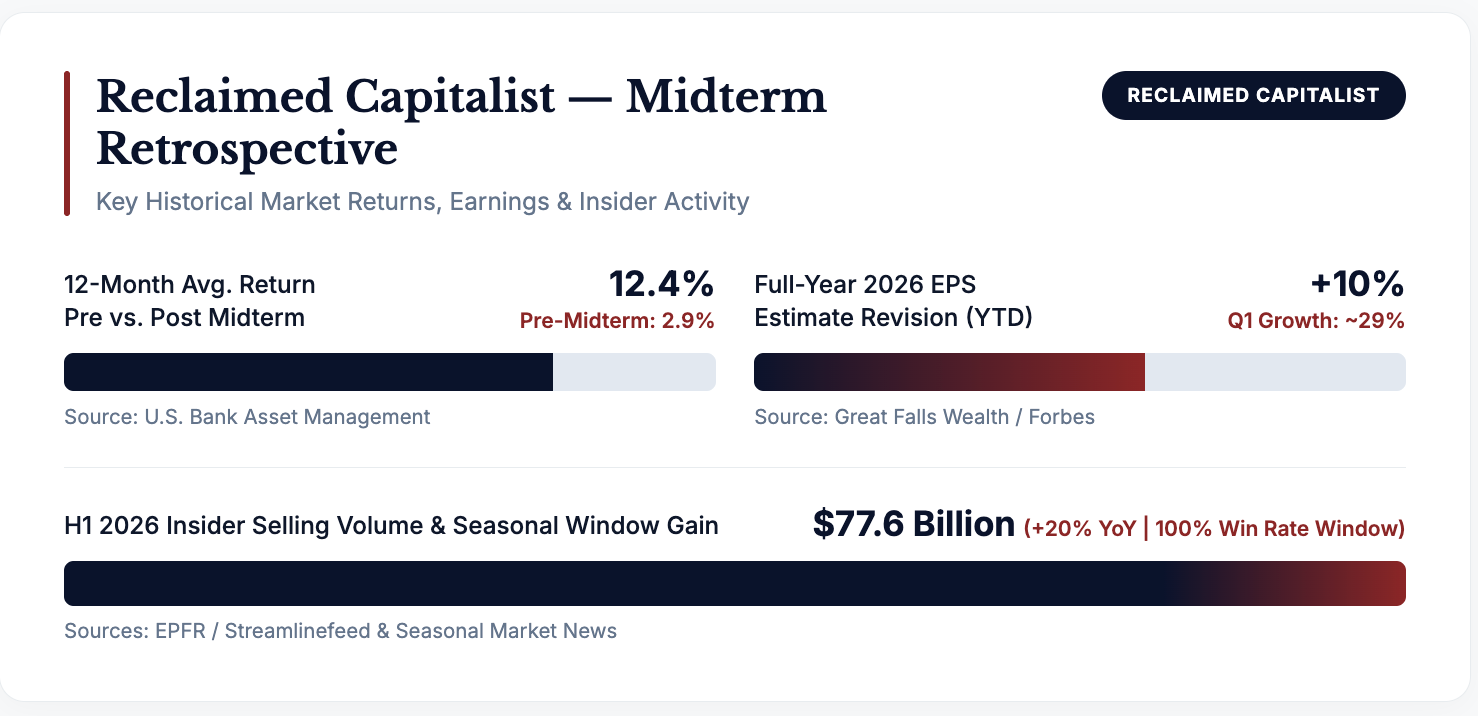
Forbes confirms that 85% of firms reporting so far have beaten estimates. They posted profits 15% above forecasts. Full-year 2026 EPS estimates are up about 10% so far this year. That is the second-largest upward shift in the past two decades.
The gap is clear: insiders are selling into strength while earnings stay solid. This is not a clash. This is smart de-risking ahead of a known rough patch. They are locking in gains before August and September bring lower volume, seasonal drag, and political noise.
The signal for Individual Sovereigns is not to follow insiders out the door. It is to see that their exit creates the very dip that has led to the strongest 12-month return window in the cycle.
My #1 stock pick for 2026
TA massive data leak just exposed the secret weapon of one of the world's most powerful AI labs.
And 60-year Wall Street legend, Marc Chaikin, believes it could become the most important investment of 2026.
The technology is codenamed Project Tengu.
It already erased $1 trillion in market value from some of its competitors -- in just six days.
I'm talking about popular stocks like IBM... LegalZoom... and CrowdStrike.
But according to Marc, Project Tengu is just getting started and more waves of selloffs could be coming.
In Marc's latest public briefing, he reveals exactly what's ahead – and the one little-known stock that could position you to profit from this entire disruption.
You see, the firm behind Project Tengu -- which Time magazine calls "the most disruptive company in the world" -- is preparing for what could be the biggest IPO of 2026.
And there's a publicly traded $40 stock that gives you a rare "backdoor" into it – right now, before that IPO happens.
This stock recently triggered the exact same proprietary signal that flashed before Nvidia, Apple, and every other member of the Magnificent Seven soared dramatically.
Right now, Marc Chaikin is telling his 800,000 followers to BUY this $40 stock - before the end of the month.
You can get the name and ticker symbol, 100% free, by watching my urgent interview with Marc before it goes offline.
Click here to get the name and ticker, 100% free.
Regards,
Kelly Brown
Senior Researcher, Chaikin Analytics
P.S. The "smart money" is quietly loading up on Marc's No. 1 stock pick under $40.
Hedge-fund giant Renaissance Technologies, with over $60 million in assets under management, recently initiated a brand-new position. Meanwhile, multibillionaire Steven Cohen nearly tripled his stake in a single quarter...
And the window for you to get in early could be closing fast.
So I highly recommend you get all the details before the rest of the market catches on.
Click here for the full story now.
(ad)
The Consumer Layer: Stress Beneath the Surface
Corporate earnings are strong. The consumer is not.
Morgan Stanley surveyed 2,000 U.S. consumers. The net outlook score came in at negative 10%. That is up from a low of negative 18% two months ago. But the key word is still "negative." More people feel bad about the economy than good.
The spending data confirms the split:
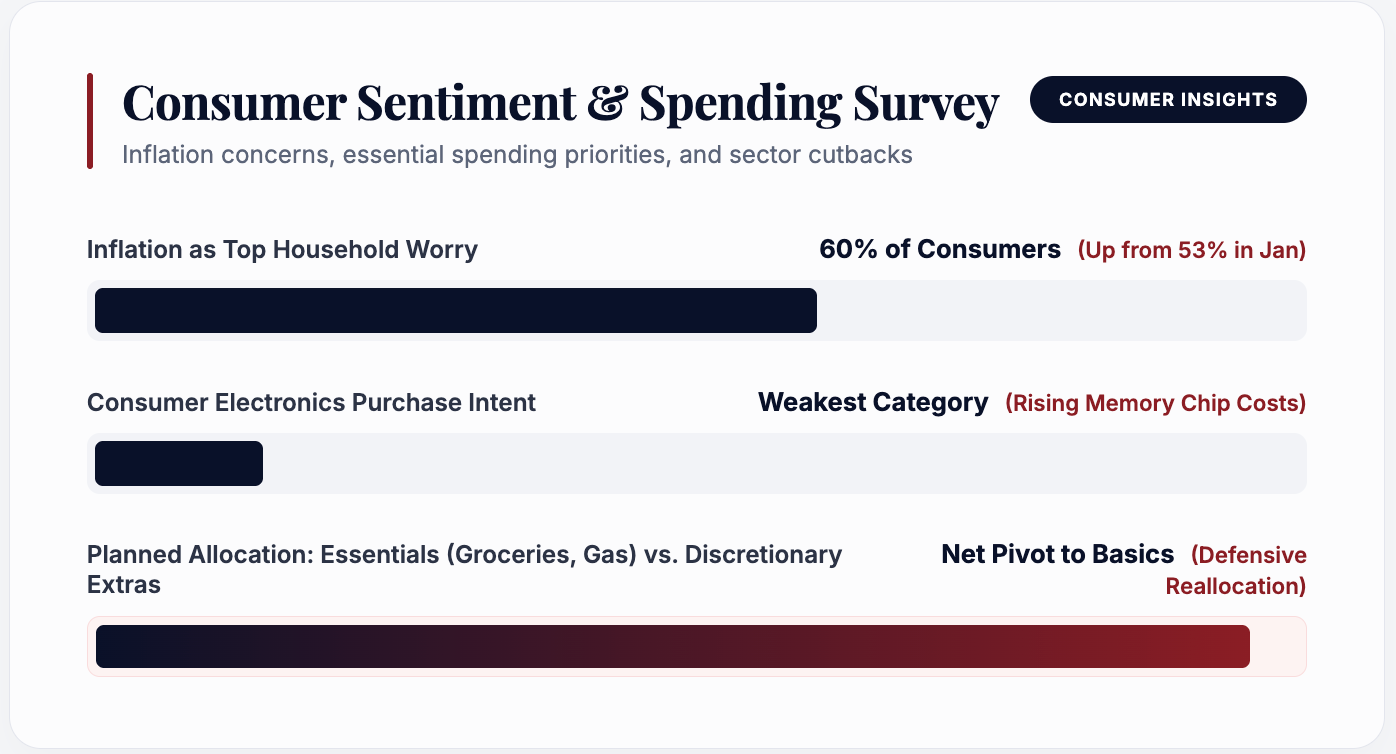
The Fiscal Times notes that the University of Michigan's Consumer Sentiment Index rose to 54.4 in early July, up from 49.5 in June. That sounds better. But it is still 12% lower than a year ago.
A CNBC survey of 1,000 voters found 61% feel gloomy about the economy. That is the worst reading since late 2023. Nearly half said they are cutting back on basics, including food and medical care. Among homes earning under $30,000, 60% are buying less.
Morgan Stanley projects real spending growth will slow to about 1.7% in 2026. They estimate the oil shock alone strips 30 basis points from spending. The hit lands on goods, not services.
The global picture adds more weight. With the U.S.-Iran interim peace deal off the table, WTI crude has climbed roughly 16% from its recent low to around $80 per barrel. The Strategic Petroleum Reserve sits near a four-decade low.
This is not a consumer economy gearing up. This is a consumer economy absorbing cost pressure while corporate earnings stay shielded by pricing power and margin control.
The gap between corporate profits and consumer strain defines Q3 2026. It will not resolve quietly. It will resolve through volatility.
Trump’s Bold Plan: Can He End the Ukraine War in 24 Hours? (Ad)
The Debt Architecture: Amend-and-Extend Is Not a Fix. It Is a Delay.
While equity markets digest midterm noise, the credit markets are running a different play. It deserves your full focus.
PitchBook's LCD data shows that **amend-and-extend volume** in leveraged loans hit **$106 billion** in the first half of 2026. That runs well ahead of last year's pace of about $84 billion over the same span. Last year was already the second-busiest on record, behind only 2024.
The logic is simple. The average yield for refinancing term loans via syndication is **6.7%** in 2026. That is down from 8.6% in 2024. But it is still **higher than every year from 2011 through 2022**. Refinancing at today's rates is costly. Extending an existing credit line is cheaper.
This is not strength. This is a stall.
Here is the sector breakdown:
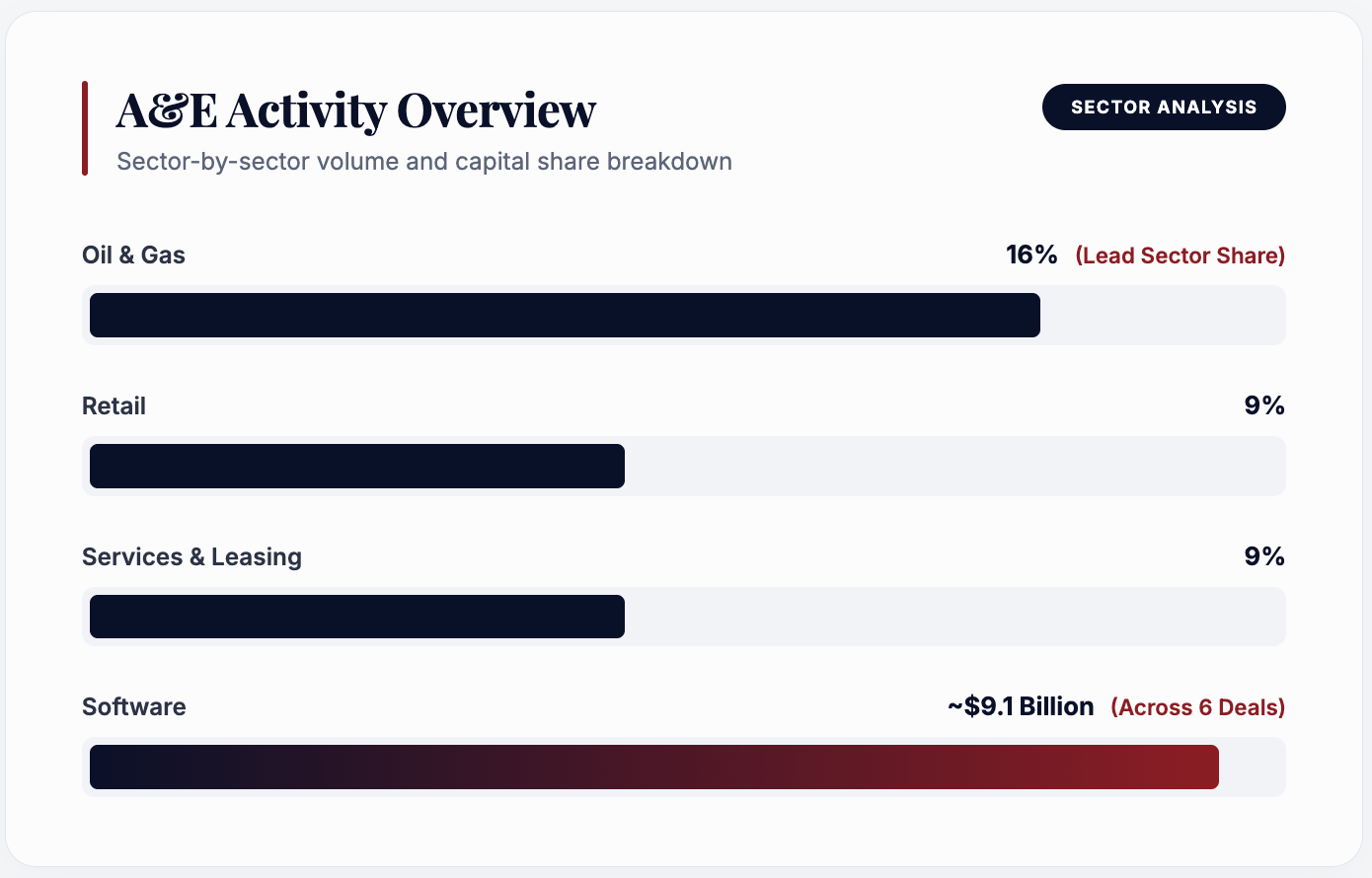
Gen Digital pushed a $4.24 billion 2027 maturity out to 2031. Athenahealth moved $4.4 billion in 2029 maturities to 2032. These are not small tweaks. These are multi-billion-dollar debt walls shoved forward by three to four years.
On the big-lender side, firms have already pushed $27 billionin 2028 loans and $14 billion in 2029 loans further out. On the pro rata side, $24 billion of 2027 maturities got the same treatment.
I have run refinancing calls at the corporate level. When the whole market shifts from refinancing to extending, it tells you one thing: marking debt to current rates is too painful. The balance sheets look clean on top. The maturity schedule tells the real story.
For Individual Sovereigns, this matters. The firms you hold through broad index funds carry debt loads that have not been repriced to today's reality. They have been pushed back. When the extension window closes, the repricing will not be gentle.
The Sovereign Directive: Positioning for the 363-Day Window
I will state this plainly.
Data from 31 midterm cycles, seven straight SPY seasonal windows, and research from U.S. Bank, LGT, Forbes, and Capital Group all point to one finding. The stretch from late in the midterm year through the pre-election year has delivered the strongest equity returns in the four-year cycle.
Seasonal Market News shows that the 363-day window starting August 1 in midterm years has posted gains in 100% of the last seven cases. The average gain is 15.07%. The median is 13.88%. Total gains across those seven windows: 165%. Zero losing years in the sample.
LGT's sector work adds useful detail. During the pre-election dip, defensive sectors — consumer staples, healthcare, IT, telecom, and real estate — have shown relative strength. After the vote, cyclical sectors — industrials, materials, and consumer discretionary — tend to lead.
The game plan for Individual Sovereigns is not complex. It is strict:
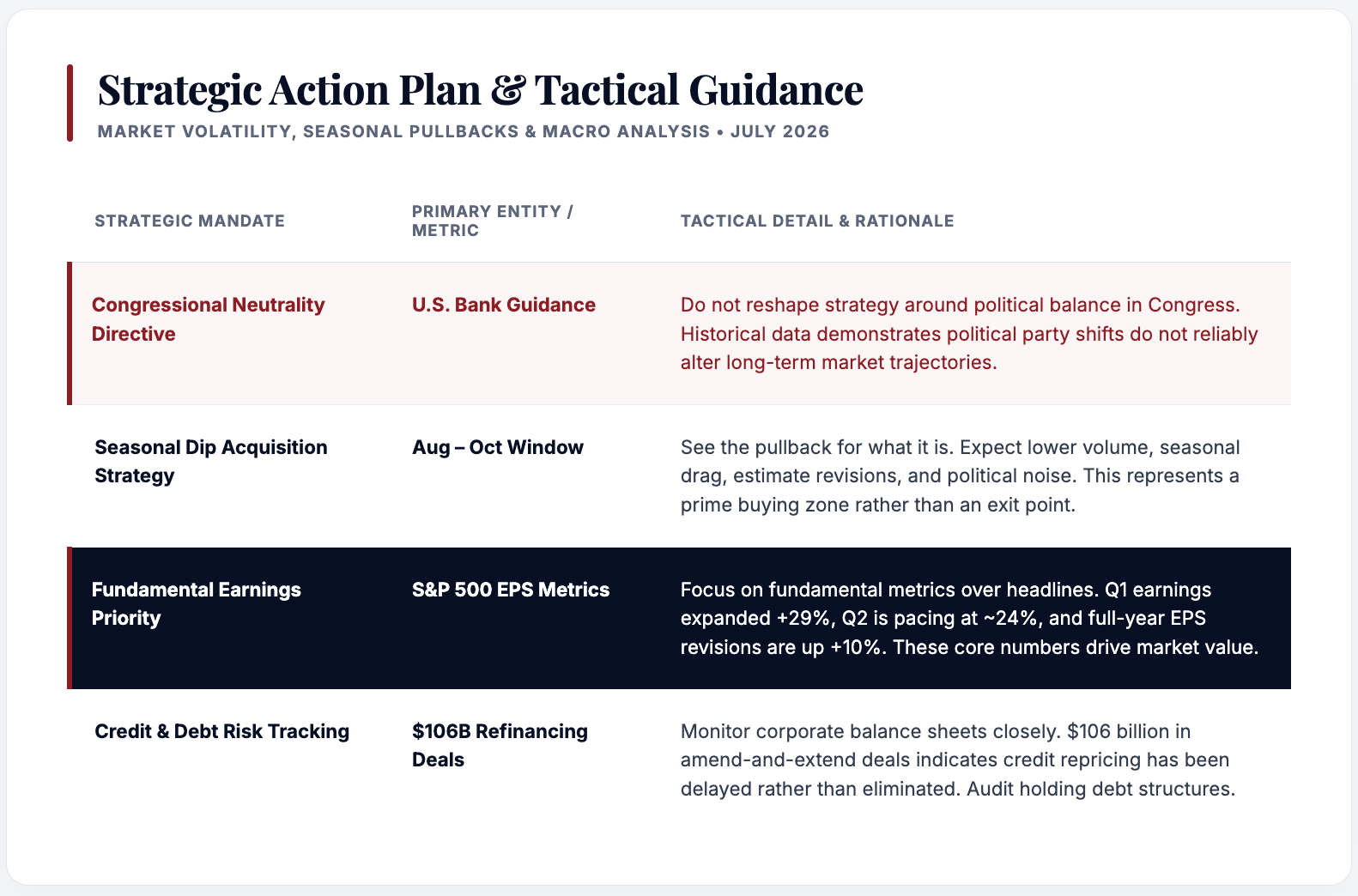
Insiders have pulled their capital off the table at record speed. The consumer is under real pressure. Debt maturities have been pushed forward. And the seasonal window with a perfect win rate opens in eight days.
This is not a market to fear. It is a market to read with clarity and deploy into with the discipline of an autonomous entity running its own capital operation.
The dip is the setup. The deployment window is the directive.
— Patrick Gibson The Reclaimed Capitalist
In partnership with Weiss Ratings
Here is my 6-step plan to protect your wealth in times of chaos
Buy?
Sell?
Hold?
If you have no idea what to do in this market, don’t worry …
No one else does either.
We have entered an Age of Chaos.
We live in uncharted territory, and the so-called "experts" on Wall Street are totally confused.
But I have a simple, six-step plan to help you protect your wealth in the chaos.
My name is Martin Weiss.
And not only have I lived through the market’s ups and downs — in fact, I’ve predicted most of them — including the savings and loan crisis, the Dot-Com Bust and the 2008 financial crisis.
The ratings system I built accurately predicted 98.3% of all banks to fail during that tumultuous time.
But I’ve also lived large portions of my life in Brazil.
I’ve experienced military coups …
Rapid inflation …
Replacement currencies …
Martial law and tanks in the streets …
So, I’ve seen a thing or two.
And in times of chaos, I always go back to a few key principles that have helped me not only survive but thrive — even when there’s literally blood in the streets.
That’s why I’m bringing you this message now.
For the last couple of years, I’ve been enjoying a well-earned retirement — here on my farm in Brazil.
I spend a lot of time swimming. And visiting with my family.
But the last few months have awakened my fiduciary duty. Because investors are confused — even desperate.
And I have the tools to help them.
So, I’ve come out of retirement to send you this critically urgent message.
We are living in an Age of Chaos.
And if you’re near my age, this could be the investing world we live in for the rest of our days.
You need to be prepared.
That’s why I’m sharing my critical, six-step chaos plan with a select group of investors — completely free.
Just watch this video to learn more.
Good luck and God bless!
Martin D. Weiss, PhD
Weiss Ratings Founder
Disclaimer: This analysis is for educational purposes only and should not be considered investment advice. Always do your own research before making investment decisions.
Items marked with an asterisk (*) are promotional and help support this newsletter at no cost to readers.